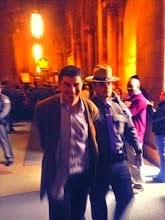
On one ride, the police chased us up the Greenway.
We are all connected to this path from downtown. An injury to any group of cyclists on this path is a reminder that all cyclists are vulnerable.
Immediately after the accident, many of us got on our bikes and rode to greet other cyclists, to check in, to connect, and support each other.
Kids still walked about, with their friends. Community members passed out candy, determined to stay connected.
My friend Nadette posted the words, "Still We Ride" on facebook, referring to the movie and slogan for the cycling movement after the city cracked down on those participating in Critical Mass Rides arresting hundreds of cyclists during the Republican National Convention.
We talked about the present moment, but our memories of past moments were with us all day.
 |
| Photo: Timothy Fadek/Bloomberg via Getty Images |
Wednesday morning I rode around looking at the city.
New Yorkers were out there riding and thriving, gawking and going crazy. Cops and onlookers were outside at the Cooper Union. what happened, i asked one photographer what happened.
"murder suicide." she shrugged and the police put up more yellow tape. The crazy beat goes on.
Thursday I rode to join the candlelight vigil by the crash scene.
Please join us for a candlelight march in Hudson River Park to honor the victims of Tuesday's heinous act of terror. The vigil will be held on Thursday, November 2. We will gather at 6 PM
at Pier 40's south turnaround, marching south along the esplanade to N.
Moore Street, paying respects at designated points along the path, and
convening for remarks at Pier 25.
We invite all to gather together and stand as a community of support.
Riding by the path, I saw people gathered by the old ghost bike for Eric Ng. A woman was praying. A man was putting up more flowers, media and police zooming about, controlling and documenting the horror. We're all a little jittery, the world trade center across the street.
Still we ride.
Riding, I recalled what New York was before 2001 and the subsequent attacks.
"My community was under attack long before this," explained a friend involved in AIDS activism, shortly after the attackis.
In class my students and i tried to imagine talking to the man who drove the car onto the bike path, killing the folks from Argentina in town for a high school reunion.
During the vigil, kids played and held candles, many wearing #10 Messi Argentina jerseys.
Cyclists zoomed by, with the sun going down in the distance.
Still we ride.


 |
| cyclists still cycling |
State
Must Remove Dangerous New Barriers on Greenway, Install Proper
Security Measures
New
York, New York -
Transportation Alternatives released the following statement
today from Executive Director Paul Steely White regarding
yesterday’s haphazard placement of concrete barriers across the
Hudson River Greenway.
Statement
from Paul Steely White, Executive Director of Transportation Alternatives:
“The
installation of dangerous concrete barriers across the Hudson
River Greenway bike and pedestrian paths is an ill-advised and
unacceptable solution to a critical security problem. New
Yorkers are particularly anxious about biking right now, and the
city should be actively encouraging more people to ride, now
more than ever. Instead, by installing these brutal barriers,
Governor Cuomo is creating another safety hazard and actively
discouraging bikers, walkers, and commuters from using one of
the country's vibrant public spaces. The 20 foot linear jersey
barriers installed across the greenway by the Governor’s State
DOT are particularly dangerous, as they are channeling two-way
bike traffic into one lane, effectively putting north and
southbound cyclists on a collision course.
The
Hudson River Greenway is the busiest pedestrian and bike path in
North America -- it is used and beloved by hundreds of thousands
of New Yorkers every year, and the city and state's current
‘solutions’ fail them in spectacular fashion. We need to protect
our public spaces without making them uninviting and difficult
to use.
Focus
group and survey findings from our upcoming
BikeNYC 2020
report conclusively show that cyclists avoid streets that are
inhospitable to them, or that reinforce the suspicion that
biking is dangerous. And so when the city fills bike lanes with
enormous concrete barriers, further limiting what precious
little dedicated bike space is available in the city, they
aren't just making commutes for thousands of New Yorkers slower
and more dangerous -- they're actively reinforcing the false
idea that New Yorkers should be scared to bike right now. This
is a sad stance for our elected leaders to take this week.
‘Temporary’,
as these barriers are purported to be, might as well be
‘forever’ in New York bureaucratic parlance. The city needs to
publicly establish a hard timetable for removal of these
barriers and implementation of more thoughtful solutions that
maintain the safety and integrity of the greenway.
There
are smart policies the city can instead implement right now --
like bollards -- that will largely and inexpensively eliminate
the risk of traffic violence, without prioritizing fear over
health and well-being. Until bollards can be installed, we
insist that the State and the City refine the placement of their
concrete blocks so that the integrity of the busiest bike path
in the country can be maintained.
New
York won't be cowed by traffic violence -- and we will show that
at a rally on World Day of Remembrance, Sunday, November 19th.
Until then, we call on the city to redouble their commitment to
the Vision Zero campaign, and smart infrastructure improvements city-wide.”
Transportation
Alternatives is also announcing the launch of a petition,
calling on the City and State to immediately remove these
concrete barriers, and instead install permanent, precisely
placed bollards on high volume bike and pedestrian paths
citywide. In October, U.S. Representatives Dan Donovan and
Adriano Espaillat introduced the Stopping Threats on Pedestrians
(STOP) Act - federal legislation to fund these bollards and
other smart tools to reduce traffic violence - in the House of
Representatives. Senator Kirsten Gillibrand has introduced a
Senate version.