Wednesday, December 5, 2012

Reimagining the City through Direct Action, Creativity and the Opening of the Museum of the Reclaimed Urban Space


One of the most fascinating parts  of my life in New York involves traversing the steps and stories of friends throughout the city.  Sometimes these stories take me through the community gardens or ways to re-imagine what the city could be if sea levels rise and climate chaos continues.  This conversation was the topic of last Sunday's "Adopting to Change" ride.  We met in Tompkins Square Park in the Center Circle. 


Sandy's storm waters surged into Manhattan, heralding a new 21st century reality. We'll ride along the new coastline, and explore both the aftermath and solutions generated in the East Village that mitigate or adapt to the realities of climate change. Ride includes discussion of practical responses that increase livability as well as long term planning options for a more resilient NYC.  All are welcome on this 2-hour ride by Green Map System, co-sponsored by Time's Up! Explore and embed GreenMap.org/nyc-energy too.

Meeting in the middle of the park, Wendy from GreenMap was there to greet me.  Peter was there to film, as were several other riders and activists.  Wendy pulled out a 17th Century Map of New York City, showing much of the Lower East Side of New York was a marsh land.


Wendy passed out maps showing possible marsh lands and rising waters in the Lower East Side based on that old map and the water we saw with Sandy.


 We toured through much of what the city, looking at various green projects and buildings, imagining what a more sustainable model of a city would be like, if we had more community gardens, such as the one we created at 181 Stanton Street this summer.  A group of activists collaborated with neighbors, who dreamed about what a vacant lot could look like it was liberated from a fence surrounding it.  We cut down the fence, started cleaning up, brought in friends, collected signatures in support of the garden, built our allies, and gained support from the community board.  When Sandy hit, this garden was one of the few spaces where water could go in an asphalt jungle.   Standing in front of the lot, supporters talked about the need to get people into the gardens, increasing the time when they are open, and helping build support for convivial social ties so social networks are in place to support these spaces before they face inevitable attacks by those who hope to privatize, bulldoze and develop such spaces.  Through the ride, we started planning gardening events for the space that very moment. 

JK and company on our tour.
 

Riding down to Delancy, we looked at the bike path coming down from the Williamsburg Bridge, imaging a different, safer kind of entrance into the city.  We talked about the underground subway station under the street owned by the MTA, wondering if the LowLine Park people have been discussing will ever work.  Others suggested parking the cars on the vacant lots below Delancey actually down there. 


A group of us rode to the East Rider, where we talked about the water rising ten feet higher than usual during the storm.  Rather than a seawall, hopefully we can create a marshes to slow the rising.  It's all part of reimagining the city.


The city is always shifting and changing with historic and social forces reshaping the ways it is organized, policed, and enjoyed.   For those in the activist world, we know each other from years of street protests, meetings, and actions.  My friends Lesley Wood and Marina Sitrin are a part of a cohort of activist friends I know from a five year period from the late 1990s, as we fought Giuliani 's attacks on public space, as well as the steamroller of corporate globalization, building a global movement, only to watch it morph into a peace and justice movement after 9/11.  They are friends I love seeing at Occupy actions a decade later.  I also owe them much as scholar activists who allowed me to interview them for my dissertation on pleasure and social movements.


This Thursday, we will continue a conversation we have been having about activism for a dozen years, at the Bluestockings, where I interviewed Sitrin and others for my dissertation years ago.

Thursday, December 6th @ 7PM – $5 Suggested
Discussion: Local Conditions and Global Movements – Direct Action, Creativity and Strategy


Featuring: Benjamin Shepard, Marina Sitrin, and Lesley Wood
What are the conditions that allow local organizers to build off of protest in other cities and places? How do local histories, successes and patterns of communication affect our ability to incorporate new ideas? How can we create opportunities to be more open, creative and strategic in our movements? These questions will launch a conversation with Marina Sitrin, Ben Shepard and Lesley Wood.

Benjamin Shepard is the author and editor of six books including “Queer Politics and Political Performance: Play, Pleasure, and Social Movement,” “White Nights and Ascending Shadows: An Oral History of the San Francisco AIDS Epidemic,” “From ACT UP to the WTO: Urban Protest and Community Building in the Era of Globalization.” Marina Sitrin is the author of “Everyday Revolutions: Horizontalism and Autonomy in Argentina” and “Occupying Language” in the Occupied Media Pamphlet Series. Lesley Wood is the author of “Direct Action, Deliberation and Diffusion: Collective Action After the WTO Protests in Seattle.”


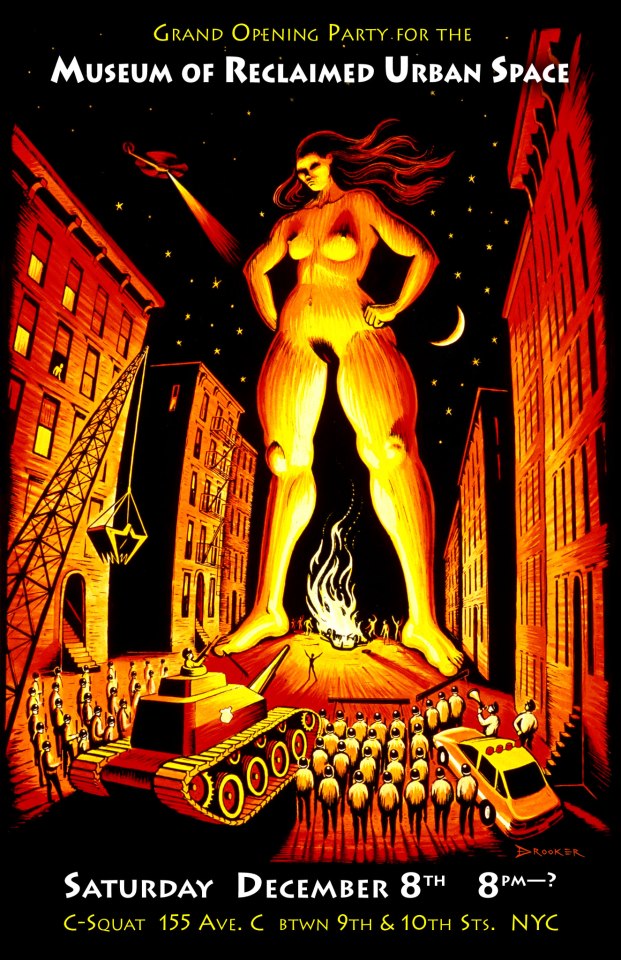
Satudurday, we will continue this conversation about regular people reimagining public space at the opening of the Museum of Reclaim Urban Space.  Much of the genesis for MoRUS was born of conversations, bike rides, garden tours and readings.  Over the years, Times Up! has held countless garden tours, looking at the history of gardening and non-polluting transportation.   Much of the activist perspective on this history is being whitewashed away, argued Bill Times Up!, echoing Sarah Schulman's point from the Gentrification of the Mind.   Changes don't just happen, people make them happen.  AIDS drugs were not released because the US government became nice.  AIDS activists forced them to do the right thing.  Gardens are not preserved because the city likes them.  They are there because people fought for them.  Looking at this history, Bill suggested we should open a museum to highlight the real history during a summer 2011 garden tour organized by Times UP!

 
\
Times Up! garden tour 2011. Photos by Erik McGregor


Later that summer, I organized a reading on our book The Beach Beneath the Streets: Contesting New York's Public Spaces.  Laurie Mittelmann , from Times Up!, was there taking notes on that history.  A writer who has long chronicled the stories of New York's activist community, Laurie worked with Bill to help organize volunteers, procure a space, and start holding radical history tours of the Lower East Side.  The result was the Museum of Reclaimed Urban Space.

MoRUS tour spring 2012. Photos by Eric McGregor
 

The space highlighted the local history of the Lower East Side and New York, looking at the ways regular people have been able to have an impact on our city, its history, and public spaces. The museum highlights efforts to support non-polluting transportation, of activists organizing bike rides making streets safer for cyclists, years before the city create bike lanes.  It also highlights the efforts of activists to fight to save gardens.  Downstairs in the basement of the museum, Bill placed signs from Zuccotti Park as well as a cardboard bulldozer we used to help attempt to bulldoze the building placed on the site of the Esperanza community garden after it was bulldozed.  This was a space where regular people celebrating people's victories in creating a more sustainable city.

Bulldozer attacks bulldozer smashing into Donald Capocia's building where eseranza garden once stood.
Top Photo by Gamma Blog
Bottom by Jefferson Siegel
 

Ironically, this document of sustainability was flooded by Hurricane Sandy.  I walked down into the basement the day after it was flooded, finding the bulldozer soaked. Immediately after it was flooded, people from the community came to help support the space, while offering free meals to those in the neighborhood from food procured from dumpster dives.  Times UP! set up energy bikes and charged people's phones. The direct action of the day was care and connection. 
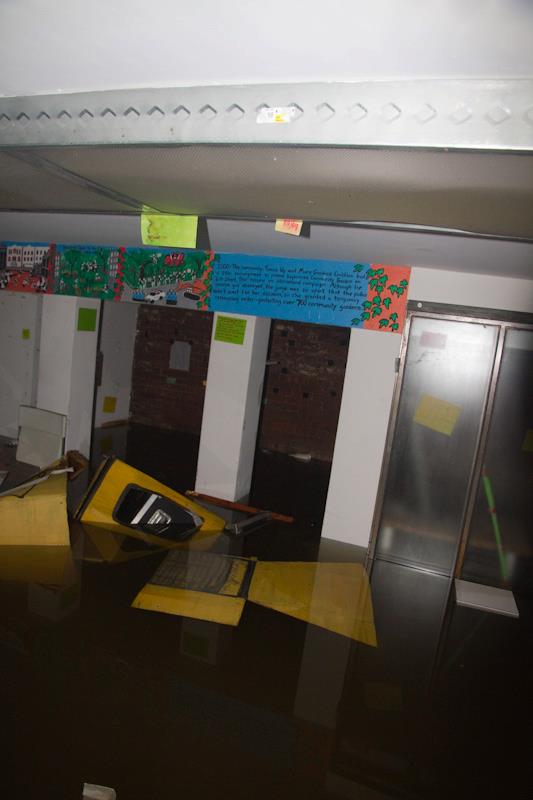
Flooded bulldozer in MoRUS basement the day after Sandy.
 

The space opens this Saturday. 


MUSEUM OF RECLAIMED URBAN SPACE TO OPEN IN NEW YORK’S EAST VILLAGE

Volunteer-Run Organization Throws Kick-Off Party to Preserve Local History


NEW YORK (November 26, 2012) – The Museum of Reclaimed Urban Space (MoRUS) will open its doorsto the public on Saturday, December 8 at 3pm following a year’s effort by community members and the museum’s all-volunteer staff. This museum and archive of urban activism is itself the latest instance of the collaborative spirit of New York City’s East Village.


Originally slated to open in mid-November, MoRUS was forced to push back its grand opening date due to flood damage following Hurricane Sandy. In the days following the storm, MoRUS created a cell phone charging station for the community using a bike generator lent to the museum by environmental group Time’s Up! The energy bike has received mention in the press, from The Wall Street Journal and NBC News to RT. Volunteers are now in the process of restoring the damaged basement for the December 8th opening, and the museum has created a campaign on Indiegogo to raise additional funds.


Saturday’s afternoon events include a chain-cutting ceremony, museum and community garden tours, slideshows, and presentations by community organizers. The grand opening party starts at 8pm and will feature food, drinks, and music, including an appearance by the Rude Mechanical Orchestra, East Village’s own radical marching band.


Co-founded in 2011 by Bill Di Paola, founder of environmental organization Time’s Up!, and Time’s Up! volunteer Laurie Mittelmann, MoRUS is located in the building also known as C-Squat, a former squat that is part of the very history the museum aims to preserve. C-Squat is now in the process of becoming a low-income housing cooperative, and its residents are among those who helped build the museum.


MoRUS documents how sustainability and local activism took root and flourished in New York City. Today’s widespread trend toward sustainable communities can be traced back to the history of transformative grassroots initiatives in the East Village. Over the last forty years, community members and local organizations repurposed many abandoned buildings and vacant lots into vibrant community spaces and thriving community gardens that are still enjoyed by the community today.


MoRUS will share the story of the East Village’s radical evolution through three main programs: walking tours of the neighborhood’s community gardens, squats, and sites of social change; photograph, video and article exhibits; and events featuring local artists, activists, and skill share workshops.


###


The Museum of Reclaimed Urban Space (MoRUS) is a history museum and living archive of urban activism that aims to preserve the rich history of grassroots movements in New York City’s East Village and showcases the unique public spaces for which the neighborhood is renowned.


We will kickstart the event at 3 p.m. with a chain cutting ceremony led by Councilmember Rosie Mendez. Afterwards, please join us for presentations and talks by Adam Purple, Seth Tobocman, Fly, Pete Missing, Ben Shepard, Frank Morales, as well as Reverend Billy & The Church of Stop Shopping and members of Bread and Puppet Theater. The Rude Mechanical Orchestra will lead a march at 8, and we'll end the night with a grand opening party, also at 8, with music by DJ Dirty Finger, RMO and more, as well as plenty of food and drinks.


I'll be reading at 5:30... please join us!!!!!!!!!

And lets celebrate what the city might be together.


The other day, Caroline asked me what I thought I would be doing with activism for the next decade and I said I would be looking at how to help New York become a model city for city for sustainable solutions.  Join these conversations this week, as we all reimagine our city. Now when I look at space, I see ways to open it open.  Last night at Jalopy, there was a sign on a fence with an add a signing from 596 Acres saying we should open this space.  More than ever, today we need to reclaim public space for the people. 


Sunday, December 2, 2012

AIDS Activism and the Places It Takes Me: World AIDS Day Blog


All these years later and AIDS activism still takes me through cycles of emotional spaces - from joy in imagining all we can do, to the sadness at the limitations of greed, of science, the connection as we take care take care of each other in times of need, and the regret for the cruelty we sometimes inflict on each other.  These are all some of the experiences of coping with AIDS. They are a few of the emotions which have accompanied the last two decades of my growing up and finding a sense of meaning in this world.  "AIDS is like the polishing on the soul" my friend John Calliau explained in San Francisco decades prior.   It illuminates what we can be and so often what we are. 


A few weeks ago, my friend Jay Blotcher wrote inviting me take part in a panel he was organizing up state on AIDS activism and the film "How to Survive a Plague"    Jay has helped with so many writing projects, queries, and stories over the years so I was more than happy to try to return the favor.  Every year I try to honor world AIDS day and the many friends I have seen shuffle in and out of this life.   So, this panel represented a small way I could contribute.  I would participate as long as I could speak my mind I told Jay.  This is the third major documentaries which covers the history of the Treatment and Data committee of ACT UP.   As long as I could mention my concern that other committees such as Housing, Women, and Syringe Exchange needed due attention then I would be happy to attend.  And Jay was fine with that. 


One final reminder to Hudson Valley neighbors; Come to this World AIDS Day event tomorrow (Sat, Dec 1, 2pm). Director David France will appear in person at the screening of his award-winning new documentary "How to Survive a Plague" at Rosendale, NY. Rosendale, NY.  I will moderate a panel afterwards with France, ACT UP veterans Victor Mendolia, Linda Meredith, Neil M. Broome, Gerri Wells and Benjamin Heim Shepard, and local AIDS prevention specialist Tony Beaudoin of ARCS. Tickets at the door ($7 general/$5 members, students) will partially benefit the Hudson Valley LGBTQ Community Center in Kingston, NY.  

Several panelists noted that there are other films and stories about ACT UP, including United in Anger.
 

Driving up from city, the GPS took me across Canal, through the Holland Tunnel, New Jersey, and into New York where peaceful country roads brought me down Main Street to Rosedale New York.  Looking at the hills in the back of the Rosedale Theater, I wondered how I had found myself in this gorgeous place.  It was like a time outside of time, a small town with a lost picture show like movie theater, on a main street lined with mom n pop shows, a small corner deli, and a shop selling Tibetan imports. I could get lost in a town like this and never leave. 

Scenes from Rosendale New York.


On my way inside, I stopped for  some soup, took in some of the character and walked back to the theater.  Inside, the concession stand was selling popcorn. 


 Jay was there to greet me.   He invited me to sit with himself and fellow ACT UPper Neil Broom. 


The lights went down and the screen filled with images of ACT UP's 1989 zap of City Hall.  "This is a very well organized demonstration," notes an anchor women with CNN. We follow Peter Staley through his well chronicles journey from Wall Street into AIDS activism, fighting to push the federal government and later drug companies to research, approve and distribute medications which will save both himself and a generation.


In the meantime, Staley and his comrades from the Treatment and Data committee must content with a struggle over red tape, barriers from the government, bitter infighting from within the movement, and ever present losses. 

Rafsky speaking by Tony Autoharp
 

A driving storyline of the film are the struggles of Bob Rafsky, ACT UP's former media coordinator, who famously zapped presidential candidate Bill Clinton, putting AIDS on the presidential agenda.   Despite all the success of his push for parallel track fast tracking AIDS drug approvals, the medications do not come fast enough for Rafsky, who we see chiding a drug company executive noting that the black mark on his face is a KS lesion.  In between birthday parties and trips to the theater with his daughter humanizing the activism, we witness Rafsky deliver a eulogy for a friend carried out of Judson memorial church.  Eric Sawyer holds Rafsky as his talks about the sword of Damocles hanging over everyone's heads and the ways their souls will contend with this, paraphrasing from Pericles' funeral oration from the History of the Peloponnesian War.  It was only a few short months into the Clinton administration before Rafsky would shuffle off this mortal coil himself. 
 
Gradually several of the heros of the film are lost.  We laugh at his rendition of Jesus Chris at Stop the Church before watching Ray Narvarro consumed by the virus. 


Those years from 1992-1995 were when I first became involved with AIDS activism, just as movement fatigue was settling in.  News from the International AIDS conference in Berlin suggested few of the approaches taken toward drug research were producing any results. The mood was as grim as ever with AIDS death rates reaching their highest rates in 1995.  The papers were filled with obituaries of people with HIV/AIDS.


Yet, then in 1996 something remarkable happened - the treatment breakthrough which had long eluded activists and scientists was achieved.  And those who been sick became well again.  You could see the KS lesions which had been on people's skin disappear noted Mark Harrington.  Staley recalls watching himself and  his friends all of a sudden get better.  The treatment worked.  And activists who had thought they were going to die for a decade started to realized they would live.


The film's most moving scenes follow close ups to the faces of the members of the Treatment and Data Group two decades later, having survived, and in some cases coping with survival guilt.  Why did we survive while others did not, they ask over and over, wishing the treatment had just come earlier. 


Despite all my misgivings going into the movie, I was more than moved by the accounts from activist heroes such as Jim Eigo and their lesson that regular people really can make a difference in this world.  It is impossible to watch this movie and remain cynical about the ways regular people can really impact change. 


After the lights went up, David France, the film's direct stood to speak.  He described editing the film's initial edit of 13 hours into this.  We literally had to edit out lives, recalled France.  He was also more than ready to admit the film only covered one of many AIDS narratives, a small section of ACT UP, omitting group's such as ACT UP's housing committee which later became Housing Works, who have stayed active.  What the film does remind audiences, who were unaware, that all this really did happen.  Many audiences had no idea.  And many thought the government improved its response on its own, explained France echoing Sarah Schulman's argument from her work The Gentrification of the Mind.  France was quick to point out that ACT UP is still active.  Yet, the film has forced many, including former Mayor Ed Koch, to rethink his views of what happened during those days, and what the legacy of AIDS activism should be.  Koch published a review of the film in which he praised the group, in his own mea culpa for the record.  


Jay Blotcher invited the rest of us up for the panel asking us about our initial impressions.   Gerri Wells confessed that she had cried through much of the film.   "There were so many barriers we had to dispel," she explained, brandishing her old ACT UP bullhorn.  "There so many barriers.  Yet, we went out and said  you are not going to get rid of us.  The government is not going to sweep us under the rug."  Despite this, Wells confessed, "it made us stronger.  Its grim... but it made us stronger."

Gerri Wells and her old bullhorn.
 

Linda Meredith followed suggesting that it was only with AIDS activism that "we realized it was ok we were queers.  Its now a model for so much research and activism.  As for the movie, she confessed she was a little disappointed.  "There were so many women who did so much treatment work not in the film."  They helped plant the seed that we could do this.  Meredith also hoped to dispel the myth that the inside outside strategy has been ACT UP's downfall.  "Its complex.  Its an inevitable thing that is going to happen once a group starts encountering some successes.


I was glad to hear her say that.  Before the film Jay and I had talked about the point that we are all sullied in this system to some extent.   None of us is pure.  Yet, sometimes, we had to get a little dirty to get something done.  Sometimes I wish people would be more willing to work the inside outside strategy than standing on the sidelines.  There is a utility in having people in teh streets and at the negotiating table. 


Jay asked that I provide a short overview of ACT UP within social movement history.  During the Indian Independence Movement, Gandhi pointed out that non-violent civil disobedience was a method in need of constant re invention and experimentation, I explained.  Over the years, countless groups build on this repertoire.   The Quakers helped stage no nukes actions.  Civil rights organizers organized lunch counter sit-inns.  And Gay Liberationists zapped the psychiatrists. 
Activists from Women's Liberation, Reproductive rights, and ACT UP built on their use of the method.  ACT UP added elements of style and theatrics to the repertoire to get drugs into bodies across the globe, breaking through barriers, challenging corporate greed.  Over the years, ACT UP helped train new cohorts of anti war activists, while supporting the Occupy Movement.  More than anything, the group lived up to Vito Russo's famous promise that after he was done kicking the shit out of this disease, he wanted to be around so he could kick the shit out this system so this never happened again.  ACT UP's contribution to this trajectory of non-violent civil disobedience was to remind the world that pleasure had to be part of process. 


Susanne Jones


 Before giving up the microphone, I also wanted to highlight the point that ACT UP was and is a collective, whose affinity groups drive the work. These affinity groups - Housing, Syringe Exchange, Women, Diva TV - more of them deserve attention. Others on the panel concurred.

As I finished Jay pointed out that Victor Mendolia  was one of the prime organizers for ACT UP's 1989 Stop the Church action of 1989.  He pointed out that before 'Stop the Church' no one questioned Cardinal O'Conner about his anti science stance around HIV prevention.  Afterward, the dialogue changed.  Gabe Pressman covered the opening of an AIDS hospice by the Archdiocese of New York.  He asked the Cardinal if it was not a little hypocritical to build a spaces for people to die, while condemning efforts to prevent people from getting sick.  "That kind of question would not have happened before Stop the Church," noted Mendolia. 


"There is another point I want to make that was not in the film," Mendolia concluded.  "ACT UP was a very supportive environment."  The group helped him feel OK about getting tested.  They also helped him enjoy living life along the way.  "It was really, really fun, supporting your whole being... even if people were dying.... you could still dance."


"Nobody was going to help us but ourselves," explained Neil Broome.  "There was enough positive energy to think we could get all of this done.  There were so many issues that people started to connect.  The behavior of  the government was so deplorable.  Yet, we stood up to say we were not going to take this."


Linda Meredith, Tony Beaudoin and several of the members of the audience chimed in that there was still a lot more to do.  We need real prevention, frank, honest non-judgmental, harm reduction based approaches to care.  Housing is prevention for people with HIV/AIDS Housing Works reminded the world this week.  The naked truth is budget cuts kill. 


And "Having HIV sucks," Mendolia reminded everyone.  

Photograph by  Susanne Jones
Jay Blotcher wrote on Facebook:
Thank you to the marvelous people who took part in the World AIDS Day screening of "How to Survive a Plague" at Rosendale Theatre yesterday. They are (from left) Gerri Wells, Benjamin Heim Shepard, "Plague" director David France, Victor Mendolia, Neil M. Broome, AIDS prevention specialist Tony Beaudoin and Linda Meredith. Thank you to all from the Rosendale Theatre Collective and the Hudson Valley LGBTQ Community Center! It was great to be surrounded by my veteran ACT UP comrades on this bittersweet occasion.
Stephen Gendin (February 20, 1966 – July 19, 2000)
One of the many lost AIDS warriors. 
 

Driving home, I listened to an old tape, Alphaville on one side, the Fine Young Canibals the other.  Feeling that bittersweet innocence of those dance hall anthems from the days as I gradually became aware of the epidemic, I recalled the scene from the film of the Names Quilt, of someone reading the name, "Freddie Mercury" who passed in 1990.   I put on "Don't Stop Me Now" and "You're My Best Friend" and played them over and over and loud.  "You make me live, whatever this world can give to me. You're the best friend that I've ever had," Freddie sang.  ÁIDS really taught me now important those friends would be.  Looking into the night, thinking of those days , the lusty fun, the dancing, and so many gone, I am glad to have known, its impossible not to both miss them and be glad to have felt the things they helped me feel.  They showed me so much about friendship and fun, embodied connection with something bigger than ourselves.  Remembering them is the debt I owe for all they have given me.