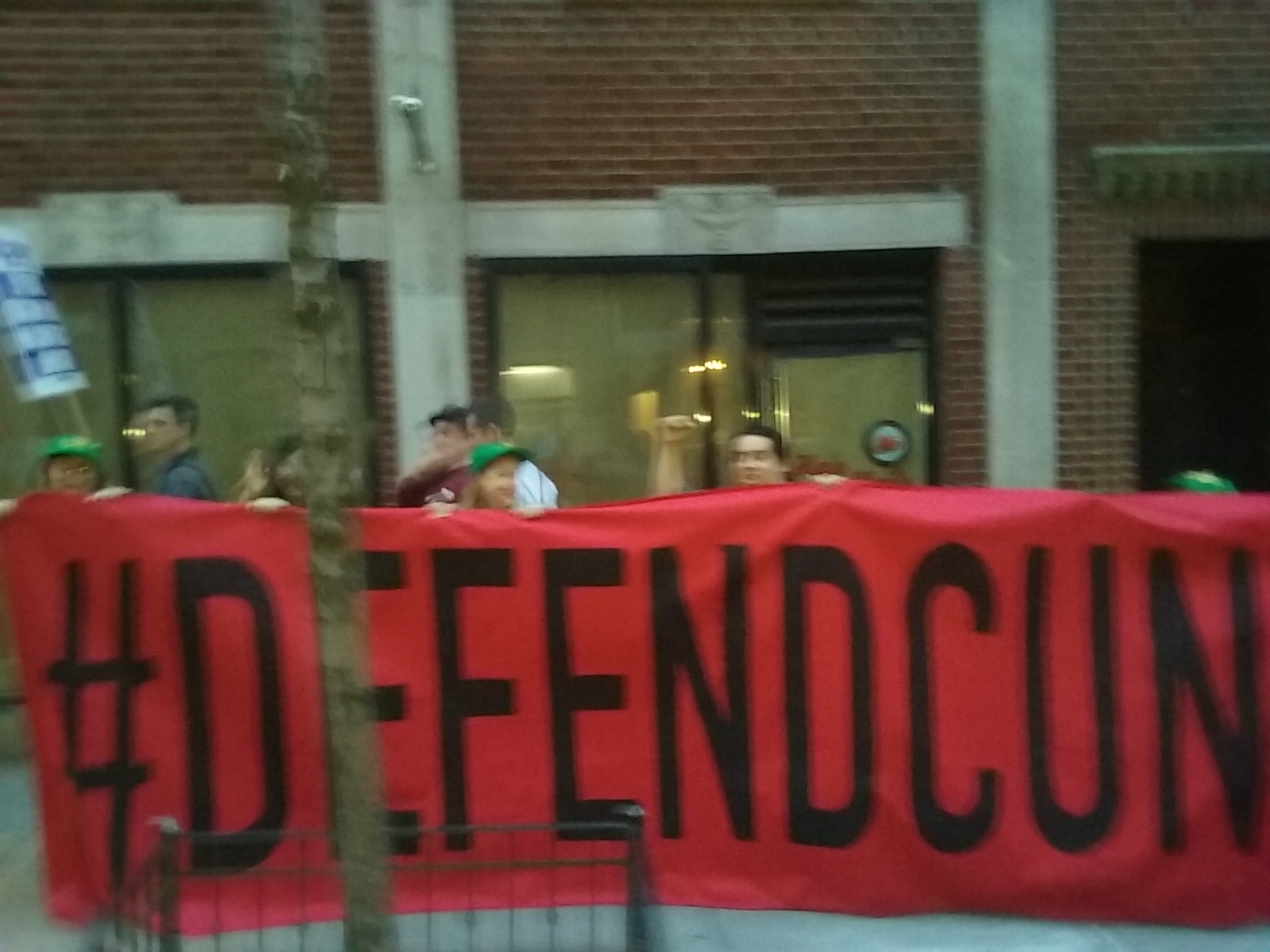
In recent weeks, students and faculty all over the city university have been organizing, holding conversations, talking about budgets, lobbying in Albany, testifying, meeting, and hitting the streets to speak up for education for everyone in this dynamic city.

 |
Hanging with my old comrade Dr Hayduk.
Photo and Caption by Minister Erik R. McGregor
City University of New York workers and students rallied outside Governor Andrew Cuomo's offices in New York City protesting the funding cuts and demanding better wages and fair tuition — with Benjamin Heim Shepard and Ron Hayduk at 366 3rd Avenue, New York. Office Of Gov Cuomo.
|
Yesterday, we hit the streets with supporters from DC37 and NY Communities for Change, the Professional Staff Congress, and many others for the first action of CUNY Rising.
Gov. Cuomo has released plans to cut state funding to the City University of New York by $485 million, despite a $1 billion state budget surplus.
Since Gov. Cuomo took office, tuition has increased by 38 percent at four-year colleges and by 45 percent at two-year campuses. Since 2008, the state has reduced its investment in full-time-equivalent students by 17 percent in four-year colleges. Currently, Gov. Cuomo backs legislation that would increase tuition at four-year colleges by $1,500 over the next five years.
At the same time, CUNY faculty and staff have been working without a contract or salary increases for over six years.
Since Gov. Cuomo took office, tuition has increased by 38 percent at four-year colleges and by 45 percent at two-year campuses. Since 2008, the state has reduced its investment in full-time-equivalent students by 17 percent in four-year colleges. Currently, Gov. Cuomo backs legislation that would increase tuition at four-year colleges by $1,500 over the next five years.
At the same time, CUNY faculty and staff have been working without a contract or salary increases for over six years.
After a rousing chapter meeting attended by Barbara Bowen, we all headed out to the rally. Faculty and students from the SGA, Human Services, and English joined us.
We began at Gov. Cuomo’s Manhattan office (633 Third Ave., between 40th and 41st streets) at 5 p.m., marching to the Community Church of New York (40 E. 35th St.) to hear about the crisis at CUNY and plan next steps.
We began at Gov. Cuomo’s Manhattan office (633 Third Ave., between 40th and 41st streets) at 5 p.m., marching to the Community Church of New York (40 E. 35th St.) to hear about the crisis at CUNY and plan next steps.
Everyone was there tell Gov. Cuomo: CUNY students deserve a first-rate college education.... CUNY faculty and staff deserve a fair raise, invest in a strong CUNY system
"No contract no way!" everyone chanted.
"Tax the rich, not the poor, stop the war on CUNY," Barbara Bowen screamed.
"Strike, Strike, Strike! Stop the Taylor Laws!"
"Teachers, Workers, Students! Shut the City Down!" the crowd chanted, accompanied by a marching band.
The spring night felt alive with promise for this pulsing city.
After the rally, Paul Krugman would write:
"...Which brings me to Governor Cuomo’s sudden proposal, seemingly out the blue, to cut half a billion dollars in state funding for CUNY and shift the burden to the city.
Full disclosure: I am now a CUNY employee. But that’s not the reason I think this would be a terrible idea. The point is, instead, that CUNY as an institution is doing such obvious good, especially in an era of growing inequality and hardening class lines, that it’s hard to understand why anyone who isn’t the hardest of hard-line conservatives would want to undermine it."
After the rally, Paul Krugman would write:
"...Which brings me to Governor Cuomo’s sudden proposal, seemingly out the blue, to cut half a billion dollars in state funding for CUNY and shift the burden to the city.
Full disclosure: I am now a CUNY employee. But that’s not the reason I think this would be a terrible idea. The point is, instead, that CUNY as an institution is doing such obvious good, especially in an era of growing inequality and hardening class lines, that it’s hard to understand why anyone who isn’t the hardest of hard-line conservatives would want to undermine it."