|
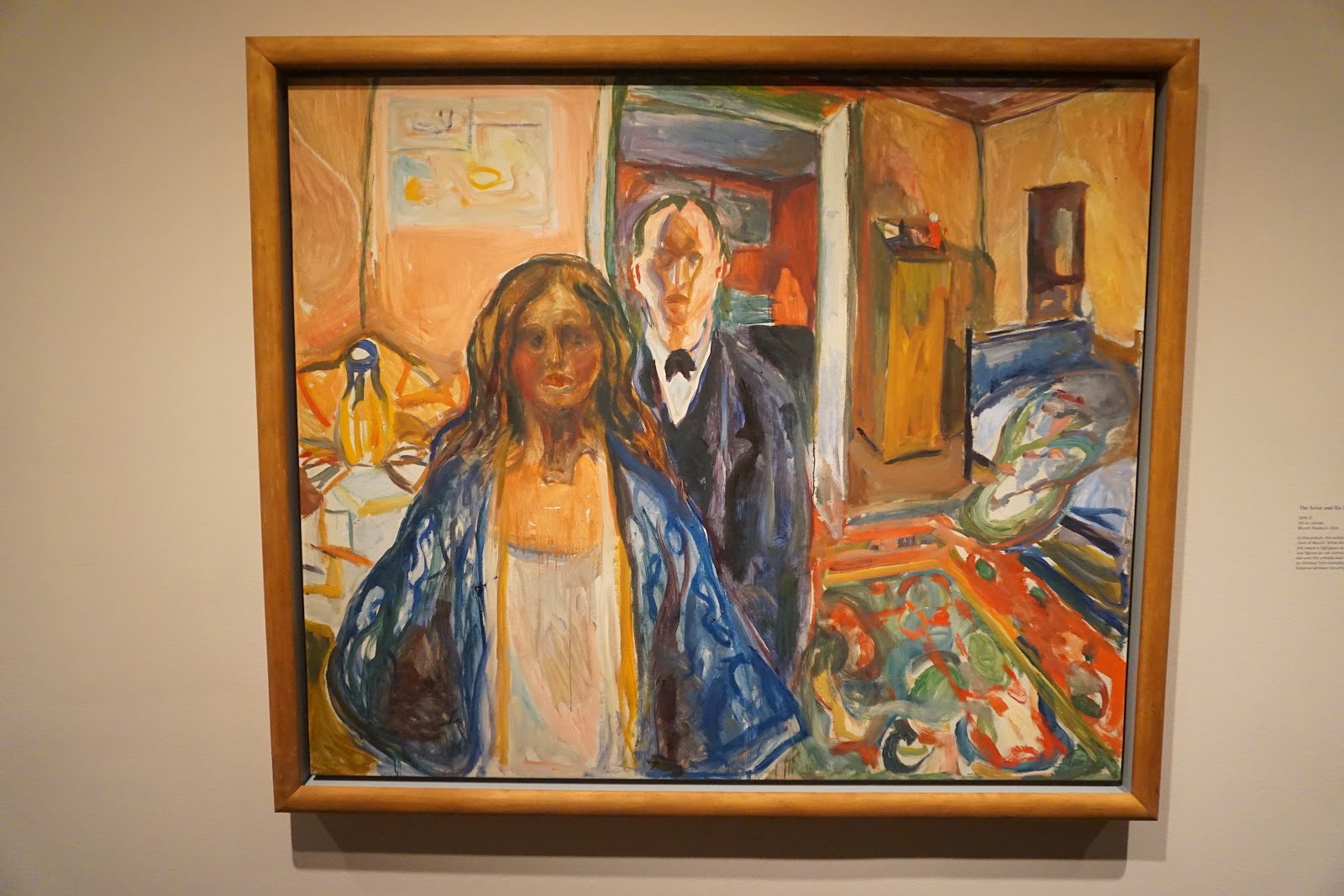
| Above, a boulevard of broken dreams late outside the house of yes on a rainy night in brooklyn, The Dance of Life, 1925, © 2017 Artists Rights Society (ARS), New York, Photo © Munch Museum / Image courtesy of The Met Museum |


 |
| high church and low |
 |
Learning from Hockney   The boulevards of broken dreams are everywhere. Fussy Lo Mein, 2001-2005 Chriss Pagani |
For
the last few weeks, number two and I have been reading The World According to Garp; she’ll sit and draw and work on craft projects
as I read out loud, exploring the life of “the bastard son of Jenny Fields,” a
writer overshadowed by his luminous mother.
We’d
forgotten that Jenny Fields, the feminist icon of the story, is shot by a man with
a shotgun at a rally, shot by a madness, threatened by unsettling ideas.
It’s
a heart wrenching conclusion to the story of an abundant life.
We
spent all weekend thinking about those lives, reading and reeling, thinking and
feeling.
The
story is an old friend worth revisiting, thinking about Robin Williams and
others who’ve left too soon.
It’s
a strange feeling to reflect on your relationships with old friends and old
selves.
Writing
my old college roommate, he mentioned a common friend of ours had recently stumbled
and fallen prey to the opioid scourge at the age of 48.
No
one was really sure. Stigma and shame are everywhere. People did not seem to want to talk about
it.
His
sister in law wrote: “Heard
really sad news yesterday bout my dad's brother Peter Coleman taken so suddenly
from us to the angels in the sky…”

I wrote a note on facebook:
For a few months there in the spring of 1989, I talked with
Peter every day. We played rugby, talked psychology, drank beer, and traveled
up and down the West Coast. Like a lot of college friends, we lost touch over
the years. I never knew what he was up to ... but to hear he's gone is quite a
shock. Wow. Peter Colemen RIP.
I
hadn’t talked to or thought about Peter in thirty years. Even then it felt as though we were all
drifting apart.
Peter
was going in one direction, my life another, even back then. Today, other
friends, Jean were somewhere else. Looking
my facebook feed I saw a message from Jean Montrevil,
who was forcibly deported to Haiti earlier in the year, leaving his kids to cope
without a dad. I used to see him every week at Judson.
I
wrote him a note. He replied
immediately. And I thought of his
kids, who go to Sunday school with my kids at Judson. Its hard to describe the feeling of seeing a
friend, hearing from a friend, and knowing they are that far away. I wonder how
the kids are handling things.
Friday
and Saturday, I watched movies about artists with the family, revisiting these old
feelings. If you love art, you are going to have to reconcile yourself with complicated
lives, Mozart thriving and Salieri envious, over and over through time. A quick
review of the Requiem, I found, the plot to poison Mozart seemed to be more of dramatic
ploy than a historic event. But the story resonated.
Friday,
I watched Control and Twentyfour Hour Party People, both about
Ian Curtis, the singer from Joy Division, who killed himself before his band’s
tour of the US in 1980. The world adored
him. New Order grew out of his work, the
story of his departure, following the band as they found space for a second act.
Even after Curtis left, the band continued performing their majestic song “Ceremony”,
a confession:
This is why events
unnerve me,
They find it all, a different story,
Notice whom for wheels are turning,
Turn again and turn towards this time,
All she ask's the strength to hold me,
Then again the same old story,
World will travel, oh so quickly,
Travel first and lean towards this time.
They find it all, a different story,
Notice whom for wheels are turning,
Turn again and turn towards this time,
All she ask's the strength to hold me,
Then again the same old story,
World will travel, oh so quickly,
Travel first and lean towards this time.
Oh, I'll break them
down, no mercy shown,
Heaven knows, it's got to be this time,
Watching her, these things she said,
The times she cried,
Too frail to wake this time.
Heaven knows, it's got to be this time,
Watching her, these things she said,
The times she cried,
Too frail to wake this time.
Oh, I’ll break them
down, no mercy shown
Heaven knows, its got
to be this time,
Avenues all lined with
trees,
Picture me and then you start watching
Watching forever, forever,
Watching love grow, forever,
Letting me know, forever.
There was something
about the way Curtis sang that “forever” that lingered in the air, an other
wordly permanence, like his departure, a looking at the stars in the distance
kind of infinity, abyss.
That’s how it felt listening
to this music on summer nights in high school.

Caroline
read his letters with his brother Theo, whom he wrote almost every day.
We
thought about it all, watching Loving
Vincent, an animated film recalling the letters and paintings of this magnificent
artist’s eight years of painting, only selling one work, before his mysterious
death in 1890 France.
““I don't know anything with certainty,
but seeing the stars makes me dream.”
― Vincent van Gogh
Everyone grapples with pain in their own ways.
― Vincent van Gogh
Everyone grapples with pain in their own ways.
The
movie ended with Don McClean’s old song, “Vincent.” I listened to the song on the American Pie
album thousands of times. But after the
film about the untimely departure and mystery of the artist’s death – whether
by murder or a suicide - it felt more
bittersweet than I had ever imagined.
Starry
Starry night
Paint your palette blue and grey
Starry night
Paint your palette blue and grey
Look out on a summer's
day
With eyes that know the
Darkness in my soul.
Shadows on the hills
Sketch the trees and the daffodils
With eyes that know the
Darkness in my soul.
Shadows on the hills
Sketch the trees and the daffodils
Catch the breeze and
the winter chills
In colors on the snowy
linen land.
And now I understand what you tried to say to me
And now I understand what you tried to say to me
How you suffered for
your sanity
How you tried to set them free.
They would not listen
They did not know how
How you tried to set them free.
They would not listen
They did not know how
Perhaps they'll listen
now.
I
guess everyone who feels suffers for their sanity. Most of us do not feel like
people are listening, or that we are heard.
We want to be heard. But to do
that, to expect that, we also have to listen.
Hopefully,
we do listen. We listen to Ian and Joy Division. More and more people take in
Van Gogh’s paintings than ever in his lifetime.
When
his writing career was tanking, the protagonist, TS Garp, contemplated ending
his life so more people would pay attention to his work.
There’s
a collective madness we’re contending with, as democracy, ebbs and flows, its
institutions gradually eroding.
Our
president wonders where’s his Roy Cohn, to defend him at any cost.
The
tax bill is already causing shortfalls in cash flow, expanding the deficit,
markets crashing.
David
Harvey dropped by our reading group on Saturday, discussing his book on the Madness of Economic Reason.
Reading
Marx helps us understand the world and workings of capitalism, he contends.
When you look at the foreclosure crisis of 2008, you saw a liquidity crunch.
And venture capitalists swooped in to profit, buying up the homes at fire sale
prices. The same thing may happen today.
It’s a way for the bond traders to assert control, Harvey concluded.
Finishing
the group, I rode over the Interference Archive,
where we were making plans for the book
launch for Brooklyn Tides, taking place March 27th.
This
community space was teeming with energy and art.
It
will be an ideal place to talk about the ways flux is transforming our global
borough.
We
read Garp the rest of the afternoon
together.
Sunday,
I arrived at Judson, looking at the bulletin for the reading for the day.
“You cannot buy the revolution. You cannot make the revolution.
You can only be the revolution. It is in your spirit, or it is nowhere.”
I thought of my days reading that book in the summer of 1987, Joy
Division playing in the background. I had stayed up all night with the book the
night before class.
I looked at the words, without putting them together, or reading
it for meaning.
The words were more than I was ready for that point. But they seem to make more sense now.
“It is our suffering that brings us together. It is not love.
Love does not obey the mind, and turns to hate when forced. The bond that binds
us is beyond choice. We are brothers. We are brothers in what we share. In
pain, which each of us must suffer alone, in hunger, in poverty, in hope, we
know our brotherhood. We know it, because we have had to learn it. We know that
there is no help for us but from one another, that no hand will save us if we
do not reach out our hand…You are free. All you have is what you are, and what
you give.”
“It's always easier not to think for oneself. Find a nice safe
hierarchy and settle in. Don't make changes, don't risk disapproval, don't
upset your syndics. It's always easiest to let yourself be governed….Those who
build walls are their own prisoners. I'm going to go fulfil my proper function
in the social organism. I'm going to go unbuild walls.”
“My world, my Earth is a ruin. A planet spoiled by the human
species. We multiplied and fought and gobbled until there was nothing left, and
then we died. We controlled neither appetite nor violence; we did not adapt. We
destroyed ourselves. But we destroyed the world first.”
― Ursula K. Le Guin, The Dispossessed
― Ursula K. Le Guin, The Dispossessed
The
world is in ruin. There is no doubt. But
the beauty is also everywhere.
I
adore the image of 1960’s Los Angeles, its swimming pools, ideas, architecture,
desserts, cacti, and characters that find their way into Hockney’s pictures.
There is a lightness that reminds me to let go and feel, to lighten up.
The
same feeling cannot be said for the Edward Munch paintings we saw later in the afternoon. The artist reminds us that feeling is laced
with challenges. The retrospective takes
us through the life course of this artist and his self portraits, haunting
nights, eering departures, death scenes, eros and inevitable anxieties, ever
present of our age.
The
Met catalog described the show:
Self-Portrait:
Between the Clock and the Bed, 1940–43 © 2017 Artists Rights Society (ARS), New
York. Photo © Munch Museum / Image courtesy of The Met Museum
The Met Breuer exhibition of works by Edvard
Munch (1861-1944), a Norwegian Expressionist artist,
gives the viewers a chance to see the paintings from the Munch Museum in Oslo and other
European and private collections. Some of the paintings are shown in New York
for the first time.
The
exhibition makes a moody and sobering impression as one would expect at a
mention of the artist’s name. Munch is known for powerfully presenting the
emotional moments of life repeating the same situations in multiple versions.
Opening up with the self-portrait which gives the title to the exhibition, the
show explores the themes dear to the artist to which he kept returning to at
different stages of his life. The exhibition will run through February 4, 2018.
Edvard
Munch was born in 1861 to the family of a medical officer. His mother and then
his beloved sister Sophie had died from tuberculosis when he was 14. These
tragic events made a very strong impression on the future artist and were later
depicted in many of his works. Munch himself had suffered from many of diseases
in childhood. Later he was haunted by depression and alcohol dependency. His
personal life was stressful and unhappy. So, naturally his works are full of
high tensions and despair.
Starting
drawing from a young age, Munch had enrolled into the Royal School of Art and
Design of Kristiania, Norway where he experimented with various expressionist
styles. He visited Paris and Berlin and sampled the artistic scenes there
coming under the influences of major artists of the early 90s. In that
productive period, he sketched or created the first versions of many of the
themes to which he kept returning, again and again, later in life.
While
he came to fame rather early in his career in the late 1880s – early 1890s,
Munch himself believed that he reached his breakthrough in art when he was
fifty. By that time he already resettled back in Norway after a turbulent life
on the move between France, Germany, and Denmark. In 1908-1909 he suffered a
mental breakdown from which he recovered upon his return to his native Norway.
The result of the emotional torments gave us his famously high-strung
paintings.
This
current exhibition at the Met Breuer presents about 50 of Munch’s works. Each
gallery in the exhibition is dedicated to a theme: Self-Portraits, Nocturnes,
Despair, Sickness and Death, Puberty and Passion, Attraction and Repulsion, and
In the Studio. This thematic rather than a chronological arrangement allows the
viewer to follow the artist’s maturity of style and the changes in technique.
As Munch was coming back to the same subject repeatedly with years in between,
the ascents of colors and the pace of strokes conveys his personal take on the
same situation over time. The FT review points
out that “these juxtapositions is at once stunning and depressing, a showcase
of genius and delusion.” A group of works under the Despair theme includes a
lithograph of “The Scream” from 1895.
Munch’s
landscapes and life scenes en plain air are characteristically unsoothing and
moody. The low skies, the broody sunsets and eery reflections of in the water
are alarming. The tensions continue in the paintings of his studio. Even the
tender embrace of “The Kiss” surrounded by the dark background while sensual
and tender, doesn’t promise a happy ending. Munch’s great genius of catching
the emotional dread and the pain of the soul is in full view here. “Who better
to guide us through our own fatalistic age?” asks rhetorically the review of
the exhibition in The New York Times.
After all, everyone grapples with pain.


 |
| Street scenes out all week with friends at Barbes and House of Yes celebrating and commiserating, |