Monday, September 16, 2013

Brooklyn Mayoral Candidates, Hospital Closings, and New Stories for the Naked City

Kings County Hospital Clarkson Street, Flatbush, Brooklyn
Photo by Irving Underhill.


Shortly after primary night, it became clear that the nominee and presumptive nominee for mayor of New York were both from Brooklyn.    An article in the New York Times suggested this shift moves the center of gravity for New York away from a Manhattan centric, pro – growth, entrepreneurial model, toward a more expansive vision of New York and beyond.  A Brooklyn perspective just might open us up to a new way of looking at all of New York, as a city which expands from Jerome Ave through East New York, rather than a subway ride from 79th street to City Hall in Manhattan.  This is the New York of the peripheries, of long subway rides, bike rides over the Manhattan Bridge, trips to the Beach, across the Throgs Neck. 

 “When I was a child I thought we lived at the end of the world,” explains Alfred Zazan in his 1951 book, Walker in the City. “It was the eternity of the subway ride into the city that first gave me this idea.”  This space which was almost all the periphery.  Like Los Angeles, it seemed to go on forever, especially on a long subway ride.  Kazin traces us through his ride from the East River, beneath the Brooklyn Bridge, past Borough Hall and Prospect Park out to Canarsie.  “We were of the city but somehow not in it,” he confesses.  “We were at the end of the line.  We were the children of immigrants who had cramped at the city’s back door, in New York’s rawest, remotest, cheapest ghetto, enclosed on one side by the Canarsie flats and on the other side by the hallowed middle class districts that showed the way to New York”.

Yet, could a new mayor who knows this ride into the periphery of our city, better understand the plight of those residing there?  Could this make a difference?  Does it matter?  After all, all mayoral candidates in New York are captive to a pro growth urban regime, notes William Sites. 

After election night in 1965, Mayor John Lindsay woke from huge accolades, to a series of municipal strikes and actions.   Somehow 2013 feels similar to that moment.


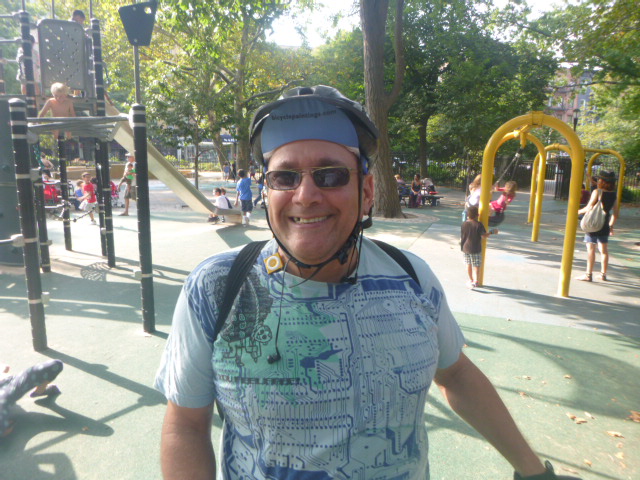
Thursday, I rode my bike across the Brooklyn, past Barklays, toward Grand Army Plaza, past the Brooklyn Museum, down Eastern Parkway bike path to attend a rally to Save SUNY Downstate and University Hospital on Clarkson Ave.

Members of my union, the Professional Staff Congress, were there in solidarity. 


I spoke with Mike Fabricant, my old prof from Hunter, about the politics of hospital closings. 
“Good neighborhoods need schools and hospitals and transportation,” he chimed in. 
Signs for  condos where St Vincent's once stood. 


The new mayor will have to put together a plan to move expired union contracts and to save the hospitals, while actually framing HIV prevention and homelessness around health, not punishment.  Certainly, de Blasio drew everyone’s attention when he stood up for Long Island College Hospital.  The way he responds to these choices will tell us a lot.  Hopefully he will choose policy options which offer a route toward a city with less inequality, a space which feels like the gap between the one percent and the 99 is shrinking rather than expanding. 

A dozen years ago few of us had heard of Bloomberg.  Yet, he became mayor by out spending a competent public advocate.  And so can Lhota.

Later after the rally, I ran into the grocery store, stumbling into Martin Amis, who has recently moved to Brooklyn. My daughter begged me not to go chat about the time I saw him read in San Francisco.  Still, I was glad to see him there.   This is the Brooklyn with many, many stories.

 That night at the pub, an ambulance from Long Island College Hospital arrived outside.  It was great to see LICH in action, not boarded up and turned into condos.  Activism saved this space, which had been destined to be closed down.  Hopefully, it saves all the hospitals in New York. 


Hopefully, the new mayor is open to more and more of the New York stories out there.  This naked city really is a space of stories.  It is a space of highs and lows, art and graffiti, climate crisis, car crashes, homelessness, and a continuing HIV crisis.  These stories come from the streets of the periphery.  

 Hopefully, the new mayor is open to engaging a few more of these stories than the highbrow narrative of the Bloomberg years. 


Saturday, August 31, 2013

Homage to Odessa, Fast Food Workers, Trips to MoRUS, and Late Summer Rides around the City

Window into what could be a garden on Smith Street. 


Some days NYC is teeming with energy and stories, street actions and bike rides.  It was a full day of adventures.  After a morning of editing, we headed for Pier Six in Brooklyn to romp about, swing, and play in the water.


Walking along Atlantic Ave, we looked at the art going up, surveyed some of the closed restaurants and vintage drinking holes remaining. 


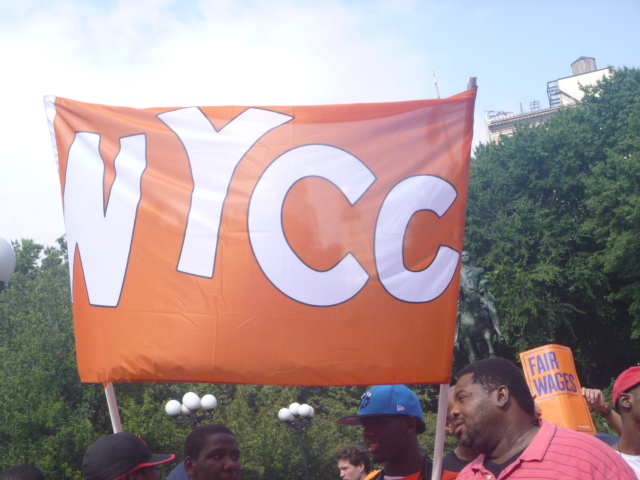
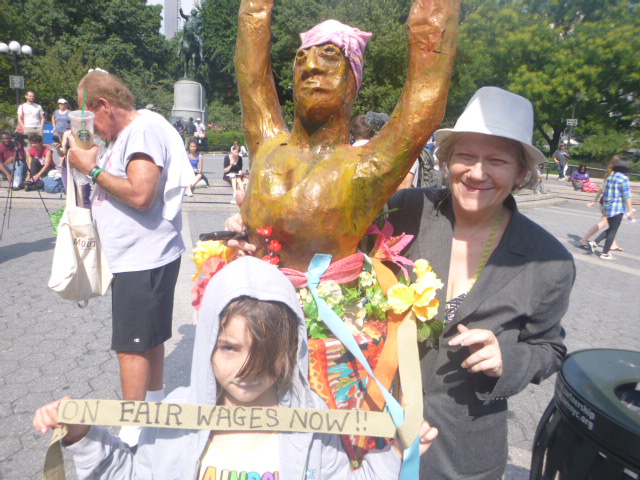
This year, we’ve lost the Rawhide Bar, last year Kate’s and the Life CafĂ©, and this weekend Odessa will close.  So the evening plans included  at trip to the old East Village haunt.  But not after a trip to Union Square in solidarity with fast food workers striking for better wages.  At Union Square they carried signs declaring: “Can’t Survive on 7.25.”  The federal minimum wage supplies a poverty salary.

“I used to work at McDonalds,” noted a friend earlier in the day.  “You can’t do it, you can’t survive on that.  You’ve got metro card, food, rent, you can’t survive on that.”


Friends from Occupy and ACT UP were at the rally.  Later in the day Tish James and Bill DeBlasio joined us.  Could it be that we’re seeing a turn in the tide toward a more progressive city?  Last that night, I’d return to the hood for the Times Up! “Free Your Mind and Your Bike Will Follow” dance ride.  Whatever one thinks of Times Up! and its ongoing democracy deficits, the group rides are always a blast, especially with Brennan on DJ leading us around NYC, to dance, talk, hang and connect with other folks in the city.


Riding we ran into CJ and Peter and the street.  At Astor Place, we danced and encountered some strange signs.


 An elder gentleman danced with us through several rounds of the George Clinton’s jams.  “Thanks guys, I gotta go to work now,” he explained off to a late night shift.  NYC is full of lovely people just trying to survive in a city full of neoliberal social controls.  The ride would end at Odessa, an East Village staple in all my years of living here.

Our last night at Odessa.  Photos by Brennan Cavanaugh

There we recalled memories of the dying haunt.  I met the broker looking for  my first NYC apartment here.  Elissa has gone there since high school.

Its been the respite from the storm for years now.  We hung here after the Occupy Charas action in 2011 getting away from the cold and police, meeting friends who poured in the police cracked down on action.

Occupy CHARAS Action top Photo by Eric McGregor
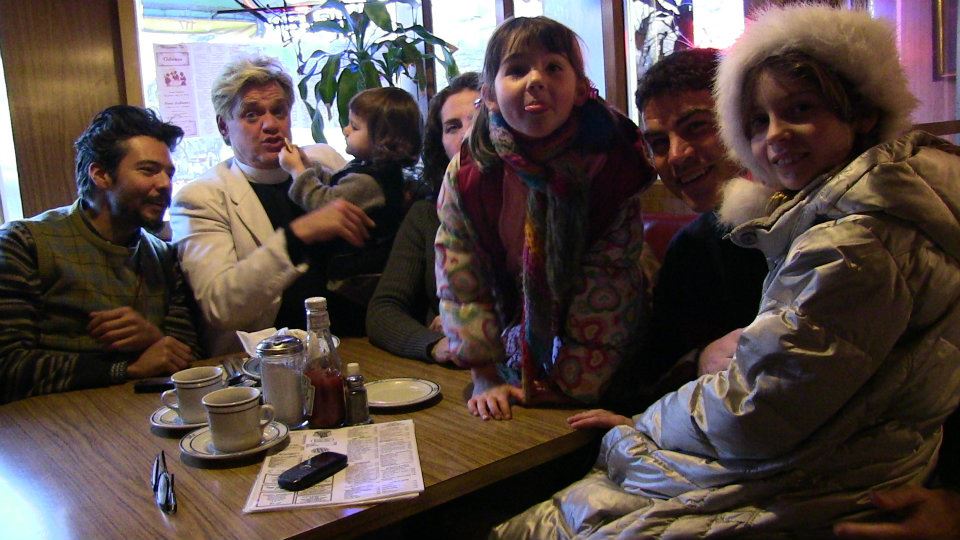
Bottom hanging at Odessa with the Rev and friends.
Photo by Peter Shapiro. 


After a February Valentines dance ride, Monica regaled us with her stories about traveling through the middle east by bike at Odessa, while we drank hot co co. 

CJ joined us while we all sat talking.     

Francesco from the Church of Stop Shopping dropped by.

Our last night at Odessa.  Photos by Brennan Cavanaugh


And then Josh.

And we all hung… all night, another night in NYC’s public commons of stories, bike actions, and meeting spots, in vanishing New York.

The next day we tried to drop by again for an encore lunch but it was already closed.  So we went next door and then ate in a 9th Street Community Garden.


Finishing lunch, we visited  MORUS.

Scenes from the permanent exhibit of the Museum of Reclaimed Urban Space.
Amanda welcomed us.

Photos from squatting and cycling activism, which changed New York.


Photos of Community Garden activism, including vacant lots turned gardens, and efforts to preserve them.

A history of cycling advocacy in New York is narrated on the steps - from the early days of cycling through increases in ridership with Critical Mass, the crackdown, and subsequent increase in ridership,
despite the ongoing attack on Critical Mass.   Amanda and Anna painted the stairs.  


Lockbox used to defend public spaces such as community gardens. 
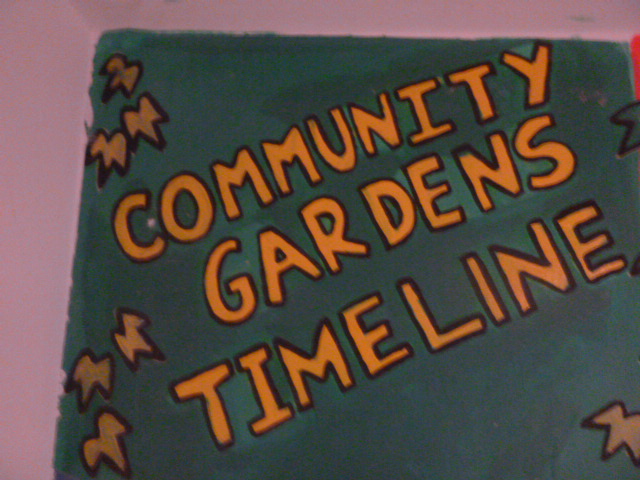
A short history of the East Village community garden movement is displayed on the walls.
Much of this movement is buttressed within struggles to reclaim public spaces, including gardens and privately owned public spaces, such as Zuccotti Park.


The museum includes the Times Up! energy bike, which helped support the movement after the city took away the power generators.   Through cycling, we created our own energy.


Finishing our tour of MoRUS, we tried to go to Odessa again, but went next door and romped around the park, in another great day of seeing friends.

A day in the park, a final trip through Odessa, and a walk home.
The photos of Odessa, are blurry as the memories will soon become. 


The talk of the town was the probable Syria strike.  Many hate Assad and what’s happening to the people there.  Others can’t stand the idea of the US doing anything in the Middle East.  Most of us feel like we’ve seen this movie before.
Seamus was gone. But his words lingered on:

History says, Don’t hope

On this side of the grave.

But then, once in a lifetime

The longed-for tidal wave

Of justice can rise up,

And hope and history rhyme.