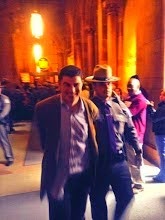
Deep inside of last Saturday’s (6/25) triumphant coverage of the gay marriage equality vote in Albany, the newspaper of record, the New York Times, reported: “A drag parade on Friday from Tompkins Square Park in the East Village to Stonewall in the West Village also went on as planned …” More than an afterthought, the annual drag march is a central event for many of us. “This is my favorite celebration during the whole of LGBTQ Month,” noted Guncle. Rather than a choreographed parade with sponsors, crowd controlling cops, and barricades separating spectators from participants, the annual drag march blurs lines between carnival and spectacle. Everything flows into itself, with few strict demarcations between participant and observer, or street and sidewalk. This 18th drag march was both a street party and a critical mass opening space for everyone, as our cavalcade cascaded through the streets and history at the Stonewall once again.
A little history: “The Drag March started as a protest against the organizers of the Gay Pride Parade (officially the LGBT Pride Parade),” notes Guncle. “During the 25th Anniversary of the Stonewall riots, this very white male-influenced and weirdly conservative group thought that drag and leather were no longer appropriate for the annual parade. Apparently they ignored the fact that it was trannies and drag queens who were the majority of rioters at Stonewall.” Trans groups planned protests and the drag march was born.
Every year since 1994, queers in New York have kicked off Pride weekend with an unpermitted neighborhood street procession in drag on Friday night. I first attended in 1999, when the rumblings of the nascent alterglobalization movement overlapped with some twelve years of queer ACTing Up in the city. The global justice movement would make its national debut during trade talks in Seattle later that fall. The burlesque of ACT UP’s rambunctious queer political tradition would find its way into much of the playful ‘tactical frivolity’ of the ascendant movement. Only one week before the 1999 Drag March, members of New York City’s chapter of Reclaim the Streets (RTS), converged to stage their own model of carnivalesque protest on June 18th, 1999. “Dancing Protestors Shut Down Financial Center to Protest Global Summit,” the group declared in a press release. The point of this movement was to make public space for the people, much like this drag march.
The Drag March was the next week. That week a friend involved from both RTS and queer organizing circles sent an email containing the following question: “Is there a DRAG MARCH this year?” His answer, “Depends on what you’re wearing.” The call highlighted the highly participatory nature of the yearly Drag March. “7:30ish or so, step off when it’s dark enough and critical mass has been achieved,” his note continued. “Permits: None,” it noted in reference to the debates about the politics of requesting police permission to participate in constitutionally guaranteed activities such as freedom of assembly. “Restrictions: Drag is how you define it,” explained the polymorphous invitation. I decided to attend, as I have almost every year since.
This year, I was running late, having arrived from Miami the morning before. I’d spent the week drafting an essay on queer activism and public space I hoped to use to promote the action as well as some of the thinking behind it.
The plan for the 2011 march was no different than other years. “Drag is what one makes it. “Dress for success? Dress down? Undress? Under-duress? Anyone can join in…” promotional material declared. “All it takes is a well spent dollar at your favorite second hand clothing store and a dream. Brought to us by the New York Radical Faeries and The Church Ladies For Choice.” Times UP!, a cycling group I work with, promoted the event on its website: “Come ready to dance. Remember nothing says resistance like drag queens in high heels. Tonight we’ll have hundreds of them. Plus a sound bike!” The group planned to bring a sound bike and ipod to ignite a dance party immediately following the march, contributing in its own way to the festive celebration of colors, streets and New York's unique culture of resistance. As usual, the plan was to meet at Tompkins Square Park (8th street entrance) at 7pm and revel in the East Village summer sun, before marching West to Stonewall Place/Christopher Street.
Friday night, I rode out from my house in Carroll Gardens, in South Brooklyn, up to Williamsburg to meet some others from Times UP! to gather the sound system. Two other volunteers with the group were there to help set up the sound bike, equipped with the equivalent of a car stereo on the back of a bike. Joe wore pink hose, a wig, and a t-shirt that declared “Trans Power.” Another friend wore a tight fitting lycra number with a bare midriff, long hair and a beard, very genderfuck. “Come Sail Away” and “I Want to Be Free” blared out of the sound bike speakers as we rode through the fog across the Williamsburg Bridge into the city. Onlookers screamed with approval as they heard the sound bike.
Harmonie Moore, aka, Brian Griffin, greeted us and offered an ipod full of drag anthems for the dance party. I love my first glance of the Faeries, drag queens, costumed village vagabonds in their colors, costumes, and glitter and connecting with friends already there. A mix between the Cockettes and the cast from Hedwig and the Angry Inch hang, anarchists mug with drag queens, trannies with clones, hippies with crusty punks, Sisters of Perpetual Indulgence and homeless people cavort together, playing drums, dancing, blowing bubbles, and sharing space in the nether zone of the East Village.
At around 7:45 the Faeries called for those in attendance to circle. Everyone gathered and held hands, as various Radical Faeries welcomed the Witches of the East, West, South, and North, with Faeries strolling through the circle to remind everyone why we are here. Harmonie Moore passed out lyric sheets for “Under the Rainbow” for after the parade, with information about New Alternatives, a social services program for homeless queer youth, on the back. Street youth were the ones who ignited the riot after all. And the bikers, Church Ladies and Faeries meandered out of the park, west on St. Mark’s Place.
People always cheer for the march. This year as they leaned out of their windows, my friend said he felt more like he was at Mardi Gras. It certainly felt that way, particularly when the ride intersected with “Queerball, a radical street party” as members of the Rude Mechanical Orchestra joined the drummers, playing "When the Saints Go Marching In". And the saints and sinners marched. More and more different groups converged, with the Times UP! Central Park Traffic Calming Ride intersecting with Critical Mass at Broadway - all headed West. At one point, a Japanese dance troupe joined the parade, dancing along.
Harmonie Moore led everyone in a rendition of the Mary Tyler Moore theme song. “Love is all around, no need to waste it. You can have a town, why don't you take it.” The sun was setting in the summer sky. Few knew all the lyrics, yet most everyone joined in for the chorus, “You’re gonna make it after!!!! You’re gonna make it after all!!!” throwing their hands in the air. The Church Ladies for Choice sang, “God Is a Lesbian” to the tune of “God Save the Queen.” Others chanted, “Arrest Us, Just Try It, Remember, Stonewall Was a Riot!” Some screamed, “We don’t’ want to marry, we just want to fuck!”
When we arrived at the Stonewall, everyone sang the familiar words
Somewhere over the rainbow
Way up high,
There's a land that I heard of
Once in a lullaby.
A little hokey, but many are still moved to connect with this piece of history. Decades later, there remains a utopian hope in the lyrics and the promise of a movement born with these words. The riot being commemorated took place on the night of Judy Garland’s funeral.
As the song ended, the Radical Faeries and RMO played drums while the dancing crowd swelled. The sun had gone down by now. Some meandered into the bar for cocktails. I ran into one of the Yes Men covered in sparkles. We talked about how hot the march had been. So much has been good this year, he nodded, looking around.
After a couple of songs, Joe turned on the sound bike to play “Fly Robin Fly.” A few Faeries started a makeshift ballet performance in the streets. The crowd expanded with “Dancing Queen.” As the street party started expanding, the police moved in, first to get Joe to turn down the music and then to push the crowd out of the streets. Last year, we scheduled the dance party for 10 pm after a brief bike ride, allowing the crowds to leave only to pump up the sound system on our return. The crowd reconverged. Joe and company danced on cars. This year, there was no such pause in the action. Instead, drag march participants – from public space groups such as the Radical Homosexual Agenda, ACT UP, and Times UP! – collaborated to hold the space.
Run-ins with police are not uncommon at the drag march. In 2008, members of RHA participated in the unpermitted action. It was just the kind of event public space activists had long defended. Yet, it was also just about shut down before it could begin.
“Who's in charge” the police asked Hucklefaery, who helped organize the event.
“No one,” Hucklefaery stammerred, bluffing for time.
“Do you have a permit?” they asked.
“I don't know?” he bluffed.
“You're all going to jail,” the cop retorted.
While this conversation was taking place, the Church Ladies led the crowd into the street. Hucklefaery turned around to see the street clogged with queer bodies. Emboldened, he informed the police, "No we're not getting arrested... where were you -- we've been waiting for you, what the hell's going on? Can't you talk to someone and fix this? They were dumbfounded...” Yet, there was a method to his negotiations. “[I]t was pleading, but also a bit bossy and... compliant as long as you did what I asked...”
Looking around the police saw hundreds and hundreds of drag queens dressed to the nines. And they gave in. For Hucklefaery the action included cornerstones of queer political performance and protest: “challenging fear,” “standing up and standing strong,” and, “for lifting me up to new heights of realization and ACTION!” Most importantly, the Drag March is informed by a bountiful energy of play. “I loved killing the cops with kindness, while you told 'em to fuck off,” noted Hucklefaery. “It was my favorite Drag March Ever!”
This year, the police were in no mood to be killed with kindness. As they pushed forward, the crowd started to chant: “Whose Streets? Our Streets!!” Joe pushed the sound system further into the crowd. And the police tried to arrest an activist from Times UP! getting in the way of the police crackdown, who stood on a police car. With a little help from the crowd, he proceeded to unarrest himself, pulling away from the police, exiting the scene, only to return in a different outfit. Unable to detain him, the police attempted to confiscate his bicycle. “That is not your your property,” an observer reminded the police, who ignored her. Yet, she insisted: “That is not your bike. You cannot take it.” As she spoke, another bike supporter inserted the pedal of his bike into the wheel of the bike and pulled backward. The scene became more and more chaotic, as the push and pull between police and activists escalated. Activists were eventually able to grab control of the bike. Meanwhile, a gentleman in a white wedding dress started talking with the police. Once again the police were going on about a permit. A few noted that the First Amendment is a permit for those wanting to “peaceably assemble” and enjoy a little of “life, liberty, and the pursuit of happiness.” “You can’t do this tonight,” the man in the wedding dress implored, as negotiations intensified. Another observer would note, “We did this last year without a permit. We let the cars through and kept on dancing.” The man in the wedding dress chimed in: “They are voting on gay marriage in Albany right now. And this is the anniversary of Stonewall. You don’t want a riot do you?” The policeman went back to community affairs and eventually the police left.
By this point the sound bike was booming. It was getting closer to 10 pm, and Christopher Street was a full street party. “Express Yourself,” “YMCA,” "Macho Man” all boomed from the sound system. After 10, rumblings came from the bar that gay marriage had passed in Albany. And the crowd broke out in applause and cheers. People wanted a New York song. So Joe put on “New York State of Mind” by Jay Z. And all of Christopher Street sang along. Beyoncé’s “All the Single Ladies” drew roars from the crowd. “If you like then you better put a ring on it.” “I was honored there to be there DJing on such a historic occasion,” Joe noted that Sunday night during the Times UP! radio hour.
As the evening proceeded, a luminal quality started to open up, spreading a feeling of possibility throughout the city. On news of the governor signing the bill, El Jardin del Paraiso Community Garden in the East Village opened into a roar of celebration. Confetti streamed through the streets. People opened windows and cheered. What a lovely city, it'll break your heart and open your heart, I thought looking into the night. Even the most cynical of the radicals reveled in the moment. While many of us have long called for queer life to extend beyond calls for marriage and military service, we were still happy with the blow against homophobia. Recall Andrew Cuomo won election in New York over openly homophobic Carl Paladino. This was a victory for a far more tolerant New York.
Leaving the Stonewall, I said goodbye to some of the Rude Mechanical Orchestra folks, noting the Church Ladies had clinic defense the following day. The RMO would be there as well. Throughout the night, many agreed that while the gay marriage victory was an important precedent, it also represented the most conventional element of the gay agenda, a conservative policy for a neoconservative age. Years before the decision, Ryan Conrad put together a Facebook page collecting critical essays on the politics of equality in an edited volume: Against Equality: Queer Critiques of Marriage. For critics such as Conrad, marriage equality represents a privatized version of gay life, a turning away from public sexual cultures, outlaw status, and the creative alternatives to marriage once offered by Gay Liberation. The volume features seminal essays by John D’Emilio, Kenyon Farrow, Dean Spade and Craig Wallse, and Mattilda Bernstein Sycamore (who attended that 1999 drag march). Many favor gay life as a freedom not to marry, as John Waters famously quipped. These writers lament the push for marriage as a spectacle which dulls the queer imagination, while excluding social outsiders. “Marriage equality …will end up being more marriage inequality” argues Kate Bornstein. “There’s no reaching out beyond sexuality and gender expression to make room for people who aren’t just like us.” The spectacle limits political space for single parents, promiscuous queers, sadomasochists, outlaws or social outsiders, in much the same way the ongoing raids on public sexual culture limit the physical spaces for those who build their lives with alternate social networks to marriage and family. “Make room for genderqueers, polyamorists, radical faeries, butches, femmes, drag queens, drag kings, and other dragfuck too fabulous to describe…” counsels Bornstein in an open letter to marriage advocates. “You cannot afford – politically, economically, or morally – to leave out a single person who bases a large part of their identity on being sex positive or in any way a proponent of gender anarchy.” Rather than cater to a model which has failed so many, created so much misery and abuse, those involved in the Against Equality collective favor a politics of “our most fantastic queer histories.” “Marriage is a coercive state structure that perpetuates racism and sexism through forced family and gender norms,” argue Dean Spade and Craig Wallse. “We still demand a queer political agenda that centralizes the experiences of prisoners, poor people, immigrants, trans people and people with disabilities.” Such an agenda favors universal healthcare, rejection of police brutality, the war on drugs and a push to create a world in which “no one is illegal.” “We reject a gay agenda that pours millions of dollars into access to oppressive institutions…” For these writers, queer life means something more bountiful than emulating tired heterosexual rituals. It means sexual freedom, self determination and autonomy from the state.
Throughout the evening, some partied. And others posted updates on Facebook. My friend, ACT UP veteran Jay Blotcher, posted he was: “Celebrating the legal victory with the man whose courage sparked the marriage equality movement in New York State: New Paltz Mayor Jason West.” Many activists such as Blotcher have spent years reconciling the converging and diverging dynamics of queer life through multiple forms of AIDS activism, harm reduction, and struggles for marriage equality. Such activism is not an either or effort. “Three cheers for the trailblazers!” posted Andy Humm. “And let's not forget that [the Gay Activist Alliance] GAA invaded the NY marriage bureau and shut it down in 1971. And the MN couple who sued to get married around 1970. It has been a long fight and is far from over.” For Blotcher and Humm, as well as many of the organizers from ACT UP, gay marriage is just one part of a larger social struggle. Yet, the goals of the GAA-focused agenda continue to conflict with those, such as the Against Equality collective, in favor of a Gay Liberation Front style multi-issue organizing approach.
Reflecting on this decade long divide, it is useful to recall that GLF imploded within a year of the riots while GAA lasted almost a decade. "The best combination was both," notes Jay Blotcher, who was friends with both GAA and GLF members during his years with ACT UP. "Which one was better? GLF showed the full fury of what queers could do. GLF had a multi faceted agenda, got a begrudging acknowledgement from the Black Panthers. GAA a bit more pragmatic and had some significant wins. You have to wonder which was right. I don’t know. It is a question that doesn't have an answer really. ACT UP faced the same thing - stay pure or sit at the policy table as Treatment and Data was able to do. Sometimes sitting at the table is useful. Treatment and Data got a lot done by not being purist. But many felt they left people behind when they did so." Those in the Against Equality collective feel the same way about gay marriage. Yet, it is certainly not a zero-sum game. “I am fighting for marriage,” argued Blotcher, who is able to straddle both sides of this political divide, supporting both safer-promiscuity and marriage equality. “But it is a rickety institution. There is something wrong in this country that someone who is married should get better treatment or benefits, whether gay or straight. This institution needs serious reform. And what is all this monogamy bullshit?"
Well, aware of all these conflicts, I still felt like something had changed in this little moment. But I was also aware that legal precedents fail to protect citizens when push comes to shove. The celebration after the 1986 anti-discrimination bill in New York did little to protect people with HIV from eviction or defamation. Old problems would remain. As I rode my bike across the bridge the night of the vote, the NYPD was busy raiding the Eagle on West 28th Street as the quality of life crusade churned forward. It is hard not to think the raid was more than a show of force by the NYPD, but a push by the mayor to gentrify and steamroller visible signs of public sexual culture. Over the last decade and a half, a class cleansing has sanitized the public commons, starting in Times Square and moving outward throughout the city. “[T]he common focus of state intervention has been on eliminating visible manifestations of poverty and deviance (both racial and national) from urban spaces,” notes Elizabeth Bernstein in Temporarily Yours: Intimacy, Authenticity, and the Commerce of Sex. The raid on the Eagle merely extends the process of pushing out signs of difference in favor of a blandified model of urban living. Sadly, the night marriage equality advanced in Albany, the city police were once again pushing out and harassing spaces for kinky queers. The suburbanization of urban space, of queer space, rages forward as the state divides good gays from bad. “"Mainstream gays have responect of the public at large, but only if they mimic those values,” notes Blotcher. Yet, he points out that many queers do not want to do so. “You're gonna see that dichotomy more and more.”
The next day, I met Harmonie Moore, who had been out partying till 5 am in Brooklyn. Several of the Church Ladies for Choice as well as RMO and Brooklyn Pro Network were on hand for clinic defense at the Brooklyn Ambulatory Clinic on 43rd Street and 3rd Ave. Members of a local Catholic church were also on hand, replete with rosaries and crucifixes, ready to harass those women seeking health care services, in some cases including abortion. Both the antis and Church Ladies vie for their space, singing songs, mocking each other, and entertaining the troops. My friend Steve, who volunteers as a clinic escort, remarked that these Saturdays are like Wile E. Coyote and the Road Runner in the old Saturday morning cartoons. They punch their clock the first thing in the morning, green each other, fight all day and clock out. The spectacle is all too familiar. Attacks on public sexuality are anything but uncommon in today’s New York.
By 10 am, the anti’s filed out, praying and snapping photos. I left to attend an anti-fracking rally , while members of the Church Ladies left to get lunch and recuperate before the Dyke March later that afternoon. Like the Drag March, the Dyke March tends to be an unpermitted affair, inviting the wrath of the NYPD who follow their own parade permit rule that posits that groups of fifty or more must apply for a permit to gather. The City Council Speaker, lesbian Chris Quinn approved of the measure without a peep in 2007. Many have come to describe Quinn as the “Deputy Mayor” for her failure to use the power of her office, as the head of the legislative branch of government, to check the power of the executive branch. In the old days before her ascent as speaker, she participated in the march. Today, the NYPD are left to harass the parade. “Three times during the march, NYPD police officers assaulted marshals by grabbing them and tearing them apart forcefully,” noted members of the NYC Dyke March Committee in a Facebook post titled “The 19th Annual Dyke March and Police Misconduct.” “This is not OK. This is another example of the NYPD’s complete disrespect for NYC’s citizens especially women.” Currently, members of the committee are filing complaints to the NYPD Civilian Complaint Review Board.
The following day, Reverend Billy and the Church of Earthalujah held a community service at Theatre 80 in the East Village. The theme of the event was: “same sex a lujah”!!! For the last two years, the Church has held “unmarriage until gay marriage” events in Central Park, holding unmarriage ceremonies for heterosexual couples to unmarry themselves until marriage is available for everyone. The action echoes Eric Rofes’ call for queers to use direct action to fight for gay marriage as many have over the years. “I guess we don’t have to do another one this year,” declared the performance artist, dressed as a televangelist turned environmental crusader in his own brand of drag. Many in the choir had participated in the drag march the previous Friday. When the Reverend ran for Mayor on the Green Party ticket in 2009, one of their early campaign events was to attend the drag march, where the whole choir, including Donald, a long time Radical Faerie, boogied. “There is a way for us to get married, man for man and woman for woman,” sang the choir, who looked like they were auditioning for Hair. Their décor, the up is down quality of the carnival of the present, the celebration of gender play, of difference, only contributed to the luminal feeling in the air. “Life is not as determined as we would all like to think,” one of the choir members declared early in the show. “There is a lot more randomness out there. Sometimes that is the best way to do things.”
“They are trying to tell us we cannot afford human services,” the Reverend lamented, commenting on the Koch Brothers and their assault on the public sector and public services. Sadly, even Governor Cuomo here in New York, has been funded by them. While he wants to shut down Indian Point, he also supports ending the moratorium on fracking. The governor is still poised to advance a neoliberal assault on the public sector, unions and the public commons, just as the police push protesters off the streets to make way for a better business climate for uneven urban development, for more condos and their owners poised to consume. Reverend Billy’s shows challenge the idea of shopping as a form of citizenship. “With this mirth is a highly serious message,” explained Benjamin Barber, who was sainted at the Reverend Billy show. “Shopping is not a sin, it is a symptom, spending billions on things we don’t want, on wars in Libya, Iraq. This is death shopping, part of a destructive interdependence . We need a constructive interdependence. Even I shop, I must confess. It's part of pluralistic democracy. It just can’t be all we do. We must also play and prey and walk in the woods.” Today, much of our public life and politics is absorbed into buying and selling. “You are not doing it, it is doing you,” notes Barber. “We need a cathedral of constructive interdependence to challenge late 20th century capitalism, replacing shopping with interdependence.” Yet, today spaces of difference, such as the Eagle, are under attack. And the public commons is being transformed into a shopping space. At various points during the show, the choir put on their own drag performance, exchanging choir robes for mustaches and bow ties for the ladies, garter belts for the men. Looking at this choir, I started to think the whole world has gone queer, including the movement still struggling for access to public space. The spectators were eventually invited up onto the stage.
In the days after the vote in Albany, the city has been dividing good gay from bad, praising the charmed few who choose marriage, and labeling street youth who build community in public space as “criminals” and “drug dealers”; “Chaos on Christopher: Iconic Village stretch overrun by drug dealers, prostitutes, violent youths,” reported the Daily News. Many of these are youth of color who have used Christopher Street Pier for over a generation. And every few years, the city whips up a panic over these youth in order to justify more aggressive policing of social outsiders. Few of these youth look like the clones of the neighborhood’s past or those getting married. In this way, Allan Bérubé, Dean Spade and Craig Wallse note the politics of equality “equates gayness with whiteness.” It divides good gays and bad, while reinforcing social hierarchies.
Still, activists such as Blotcher argue that there is a rationale for moving forward with issues such as gays in the military and marriage. “"I was working for gays in the millitary, even though I despite the military industrial complex. But I thought it was a stepping stone.” Many queer activists, including Allan Bérubé, have taken a similar position. “It’s wonderful to be a purist. But you have a shorter expiration date,” noted Blotcher. Yet, this does not mean the movement’s work is complete with the marriage milestone in New York.
Certainly there are any number of inequalities still out there. And no doubt they will continue with gay marriage and the subsequent panorama of nuptials, parties, long term romances, separations, adoptions, divorces and so on. This is all part of the marriage game. “The full catastrophe,” famously laments Alexis Zorba in Zorba the Greek, confessing the whole affair has its limits. “Am I not a man? And is a man not stupid? I'm a man, so I married. Wife, children, house, everything. The full catastrophe.” It is all part of the experience the ritual supports. Years before the practice was supported in Albany, queer people around the world participated in this ritual and recreated it in their own terms. “"You have two elements of the relationship, private and public,” notes Blotcher. “People realize how unpractical those Christian morals are. People work it out so they remake it in their own way.” Today, their gestures of freedom are recognized by the state of New York, thankfully. Yet, inequalities still persist. Queer youth kicked out of homophobic homes still suffer without a space to call home in this neoliberal city, just as services are being slashed in city and state budgets. The commons are still being cordoned off, just like the piers off Christopher Street which the NYPD and the Parks Department fenced off during the Pride Parade. But it is up to us to open them. And this is what shows such as those by Reverend Billy and Circus Amok, as well as the drag march, still do: they expand a theatre of the imagination from the stage into the streets. Through this participatory theatre, we create the possibility for something better, especially as we march and reclaim public space. Yet, this vision, the vision of a Right to the City clashes with a privatized vision of citizenship and imagination. With gay marriage moving forward in New York, hopefully queer activism will once again push for a space for difference once more. Here, queer youth find a place in this mean city; public sexuality and sexual self-determination pulse, and the public commons thrive once more as a space for difference, not police crackdowns.