


“Can we give permanence to the lightnings of thought”: Dad and the Transcendentalists, Spring Actions and Departures.
It's been a dozen years since Dad took a detour from this world, on his way somewhere unknown.
No one really knows what happens after someone goes, after a loved one dies.
All we, all I have, are the memories, a few dusty old books.
Every year, I sit on this day, Dad’s departure day, looking through his old letters, the black and white photos and marked up books of poetry and prose, psychology and philosophy, theology and literature, picking up one of the volumes I picked up on the way back from Texas after his funeral. Will and I drove from Texas to New Orleans after Dad was created, joking, eating crawfish, munching tacos after spreading the ashes, without washing our hands. Spreading more ashes all over NOLA, into the Mississippi, the river of life.
All, that's an old familiar story at this point.
Still the memories linger, offering surprises, insights, the road trip continuing.
When I think of Dad, I think of a thousand conversations, backwards and forwards, the jobs he turned down, the Thomasville Law Firm, at Princeton, on the way to class, on the road from Dickenson, leaving Carlisle, after Will's graduation, with Caroline and Uncle Louie in Moultrie, Ga, by the farm with the cows, at Dunn Brothers Coffee in St. Paul, with his feet up, in San Francisco, at coffee shop on Haight Street, among his piles of books, listening g to Bud Powell records in Chicago, on Belmont Shore in Long Beach, on the way out to Joshua Tree, to camp.
Watching the world, recalling the latest paperback he was reading of Kinky Friedman or Miguel de Unamuno, telling me about the Spanish philosopher whose travails led him through darkness and light.
I don't know who he liked more, Miguel or Kinky, who reminded us:
"Politics is the only field in which the more experience you have, the worse you get".
"The first thing I'll do if elected is demand a recount".
"We're in a race with Mississippi for the bottom, and we're winning".
"Never apologize for the truth".
Laughing, he told me about his uncles, “Calvinist sons of bitches,” all of them, he lamented, the children of John B Shepard the Ora Hewitt, Texas, his father Kirk, who went crazy in the war, beating the love out of him when he returned from the Pacific Front, Dr Carl, thrown down the stairs in an S and M accident gone wrong, Winston, who stayed home during the great war, and Louis, who who outlived them all. They all had stories, none more than Ora, their mother, who lost her first years and years before. All the descendents of Willis Simeon Bowles, whose father drowned at sea on his way back to England, 1829, orphaned; he worked in a sawmill, before he fought in the Civil War, for the wrong side, I would presume.
I think about about Dad at Harvard, as his grandfather and uncles were, thinking about the Beats and Transcendentalists of Boston and Concord, their 19th-century intellectual movement (1830s–1850s) that embraced idealism, individualism, and the divinity of nature, reacting against rationalism and materialism, looking at the mysteries, at god revealing herself in a walk in the woods, in a cemetery, in the old poetry bookshop in Cambridge ... The poems we read looking at the Pacific Ocean.
I dig through the piles of books that he left behind, stumbling upon his history of Transcendentalism, marked up passages, leaving us clues.
"Time is but a stream I go fishing in..." he underlines, sharing a passage from the Essential Transcendentalists ... all these years later…
We thought about Dad all week, taking our annual trip to his favorite NYC restaurant.
“The US has always been afraid of becoming Communist,” he’d say over and over. “But we were never close to that. What we really had to worry about was becoming fascist,” he told me. “We’re a lot closer to that,” he lamented. If only he could see us now.
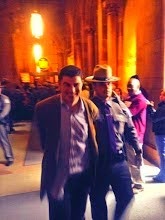
While activists were in Albany taking a bust for NY4ALL, we were at El Quixote toasting to Dad, gone 12 tears, recalling the conversations, the dialogue, the books, the stories long passed, his days staying at the Chelsea, watching football games at the bar, talking in his room, long into the night.
Dad's greatest disdain was for the ontologically challenged. The questions about epistemology, about knowing and being, seeking, never knowing. They fill me as spring awakens, the road opens.
Ralph Waldo Emerson wonders:
"Can we give permanence to the lightning of thought which lick up in a moment these combustible mountains of sensation and custom, and reveal the moral order after which the earth is to be rebuilt anew… Can we give permanence to the lightnings of thought which lick up in a moment these combustible mountains of sensation and custom, and reveal the moral order after which the earth is to be rebuilt anew..."
I remember getting arrested just a few days before Dad died, a strange feeling hitting me a few days later, that he was passing after I got back.
I always have that feeling in March, the sensation of passing, of flowers, of Spring opening, of bodies in the streets.
As usual in March, direct action is popping, activists defending neighbors, fighting for the climate, it's all opening up. See you on the streets Saturday, recalling Woody, all you fascists bound to lose.
As Howard Zinn puts it:
“"TO BE HOPEFUL in bad times is not just foolishly romantic. It is based on the fact that human history is a history not only of cruelty, but also of compassion, sacrifice, courage, kindness.
What we choose to emphasize in this complex history will determine our lives.
If we see only the worst, it destroys our capacity to do something. If we remember those times and places-and there are so many-where people have behaved magnificently, this gives us the energy to act, and at least the possibility of sending this spinning top of a world in a different direction.
And if we do act, in however small a way, we don't have to wait for some grand utopian future. The future is an infinite succession of presents, and to live now as we think human beings should live, in defiance of all that is bad around us, is itself a marvelous victory."
Wednesday the 25th of March
After teaching, with still more wondering about the world, I found myself giggling with Al and Baby C, later, uptown at an old restaurant, a men's club, with old and new friends, taking in the news, reports from the demos in Albany, activists imploding the governor to preserve New York's climate laws. Gov Hochul, don't blame Trump. Keep us on the right track. As of March 2026, New York's landmark Climate Leadership & Community Protection Act (CLCPA) faces significant attacks from Governor Hochul, who proposed delaying key emission regulations until 2030 and altering methane accounting to weaken the law. Critics claim these changes are necessary to avoid high costs, while environmentalists decry them as a major step back from climate leadership.
March 24th
Keegan posted:
“The conservative majority on the Supreme Court reversed my appellate win in Linton v. Zorn, a case where a cop was granted qualified immunity for permanently injuring a peaceful protester.
Justice Sotomayor, joined by Justices Kagan and Jackson, dissented—and are dead right. The majority inappropriately construed facts against my client to summarily reverse the Second Circuit—the evidence shows the cop gave my client no warning before twisting her arm behind her back—and this marks a dangerous resurgence of the Supreme Court inappropriately expanding qualified immunity on the shadow docket.
This is a devastating blow to me and the state of the law, but most of all to my client, who was permanently injured and now gets no compensation or justice for her suffering. It really feels like we are losing the war in our struggles for justice right now, but all these actions and cases have real human consequences, so we’ve got to keep fighting the good fight, and hoping we can bend things back in the right direction at some point down the road. At least that’s what I’m telling myself.
March 23
Met Mom for lunch, enjoying some oysters. The secret to longevity is a lot of prosecco, Mom explained, taking a sip.
March 22
Before taking the kid back to school, I found myself scrolling through the ACT UP 29 pics, putting together the ACT UP 39 blog. There's Mark Milano, Elizabeth Owens, Andy Velez gone. Other heroes still here. There's a nine year old kid and sister, up in the corner and ten years later a 19 year old college kid, acting up!!!
Up to Boston we drove, spring break over, on the way back to college.
"Don't go back to Rockville..." we sing.
"Sometimes I live in the country. Sometimes I live in town. Sometimes I haves a great notion. Jumping in, into the river and drown ... Irene good night" we sing.
"Some of the most beautiful words ever written," they said before stopping at a diner in Connecticut. "That's a damned good cup of coffee..." On the way back to Boston blues grasping at us.
I think of Dad, who spent the happiest days of his life here, strolling through Cambridge, hanging out with Mom and Fred.
“Ireen Goodnight,” I sing, remembering singing with Dad all those years ago.
Up in Boston, the teenager has a copy of “A Sand County Almanac” by Aldo Leopold.
Dad loved this ecological tome, “ a 1949 non-fiction book by American ecologist, forester, and environmentalist Aldo Leopold. Describing the land around the author's home in Sauk County, Wisconsin, the collection of essays advocate Leopold's idea of a "land ethic", or a responsible relationship existing between people and the land they inhabit.”
I wish they could compare notes, the two Transcendentalists.
Finishing writing this, I glimpse through Dad’s notes from the Essential Transcendentalists.
“The lone stryker” Dad scrawled on one page, toward the end, referring to an old poem, one of his favorites. Most of the notes are indecipherable. Baby C helps me decipher a few. You have to unfocus your eyes, says Baby C translating. I thinking about Dad’s favorite poem, “A Lone Striker” (1936) by Robert Frost, published the year of Dad’s birth. Dad read it to me the last time I saw him in this world:
“He knew another place, a wood,
And in it, tall as trees, were cliffs;
And if he stood on one of these,
‘Twould be among the tops of trees,
Their upper branches round him wreathing,
Their breathing mingled with his breathing.
If -- if he stood! Enough of ifs!
He knew a path that wanted walking;
He knew a spring that wanted drinking;
A thought that wanted further thinking;
A love that wanted re-renewing.
Nor was this just a way of talking
To save him the expense of doing.
With him it boded action, deed “
RIP Dad.


No comments:
Post a Comment