Monday, May 18, 2015

Goodbye Mellow Yellow Brick Road Ride, Reflections on the Critical Mass Panic with Mellow Yellow

promotions poster for the 2010 wnbr.

Joe is the first person I know to talk about organizing a naked ride.  It was Spring of 2010 and Joe, just new to town started organizing, tweeting, chalking, and messaging about the ride.  Everywhere he’d go, he’s chalk up the message, painting it on his body or streets. Some audiences were more receptive than others.  But it was a blast to watch.
Sometimes people were offended. Mostly they were intrigued.

"I'll see you at the world naked bike ride," he'd remind people.  After watching the ongoing attack on Critical Mass, he's still wanted to put together a powerful mass of bodies in the streets. And he did so. 

More ass less gas, we chanted during the glorious ride as our ride connected with a global movement to save the planet. 


At one point in midtown, we started to ride down Broadway second avenue with "Empire State of Mind" blaring, all of us singing, "In New York,...New York, New York..."

Everyone was a star.  We were all the leaders, pulsing through space in a gorgeous semi clothed critical mass of bodies. 

We've had one every year since he's been here.  Every year brought a different twist.


Over the previous weeks, we all hung out a lot.  Barbara and I talked with Joe about his experience riding in New York, participating in  Critical Mass, meeting in Union Square, organizing with Times UP, the Drag Ride, Occupy, and later with the Cargo Bike Collective. 

Hanging with mellow yellow, aka Joe.


“We won the bike lanes, but lost free speech,” explained Joe, April 30th after the new no police dance party, reflecting on his years of struggle against the police to make sure the ride happened. 


Some years he was arrested, others he eluded their social controls.  Every year these rides become a site of contestation, in a clash between free bodies and police hell bent on control.  He grew up cycling in Northern California, riding everywhere.   It was a way to see the world.  “Seeing homeless people, a halfway house, seeing people who are different.” By the time he got to college in San Francisco, he lived off campus where he rode a bike to get around town.  “MUNI is a joke.”  His bike was stolen and a friend gave him a 1968 Schwinn Varsity.  “She took me to Critical Mass in San Francisco.  It was fun.  You could get ahead of traffic.”  There was a distinct pride in moving up the notorious San Francisco hills North of the Park.”

1968 Schwinn


Riding the eight mile path to and from school, around the city, and on Critical Mass, Joe started to get familiar with the space, the community, etc.  “I discovered a lot, just seeing how traffic flowed.  I had never really done distances, but now I was riding miles and miles.  I made a comic about the traffic, cars zooming through space.  The cop, Officer Friendly, in the coming drives his ship into an asteroid belt, causing asteroids all over to crash all over each other.  I  was starting to believe in more possibilities.  I was an artist.  I had this great professor, Richard Kramer, who was involved with art and performance.  It was art and science.  My consciousness expanded  with my first Budweiser.”

In between stays in San Francisco and Santa Cruz, Joe started to explore anarchism.    On Critical Mass, he saw cyclists take care of each other, in a huge gesture of solidarity.

On a fateful evening he went to the Mission to see Warriors at the Red Vick.  And he started thinking about the East Coast, moving out in 2008. 

His  first Critical Mass in New York witnessed Chris Long’s brutal arrest by officer Pogan.  He was on Lombard Street when he heard about all the hundreds 500 arrests of the New York Cyclists during the 2004 Republican National Convention Critical Mass.  “I knew what was up.” 

Chris Long top right, community affairs policeman top left, and other scenes from Critical Mass Panic. 


Critical Mass opened a whole new way of thinking of Joe. “I was raised Catholic.  My teacher punched me in grade school and then she sided with my bully.  I told him his riddle was wrong.  She sided with him.  If the teacher was wrong, authority was wrong.  If they say Freddie (Gray) killed himself, then they are wrong.  Critical Mass was a space to connect with people.  I loved meeting people there, talking with people… even in New York in our darkest days, to meet and connect with people.  The other thing that appealed to me was the critical collective consciousness, informal networks as opposed to an organization.”

“My first Critical Mass ride I was behind Chris Long.  I was playing the game.  So I asked the white shirts what we could do.  They said ride in the bike lane.  Take away the joy of the experience.  Its what Officer Friendly does, disrupt the asteroid field.  The night of the Chris Long incident, seeing that had a huge impact.  We all reconvened, the three groups met downtown .  It became my practice.  It was the place I met for all of my rides.  The Beach Ride, Moonlight Ride, Critical Mass. 

Late 2008, he saw the ride as a Critical Mass Panic, inspiring his blog.  “I was commuting from Brooklyn.  I rode with Transportation Alternatives and Times Up! I saw the police panicking.  I was inspired by Billy’s defense after he was arrested for reciting the First Amendment at the Critical Mass. I was basically doing Critical Mass testing the ground, talking with the white shirts.  Why are you here?” he asked, noting that the whole thing was essentially a question of free speech.

“My first ticket  was during a Thursday ride through Times Square.”  Vlad was filming. “I said to Vlad I am not a leader but you can follow me.”  When the cops give people a ticket in SF Critical Mass, people stuck with each other, in solidarity.  I turned.  I was given a ticket.  I lost my trust in the cops.  I saw the incompetence.  This is their training exercise,”  Joe recognized recalling events, such as 143 plus arrests the night before after the Freddie Gray rally at Union Square or Occupy four years prior. 

“Bike power has come a long way.  We’re past Critical Mass with bikes.  But we need a free speech critical mass.  You need people power.”

“When I was arrested, I saw this as a training opportunity for repressing free speech.  We that system crush the critical mass ride and then co opt it because cycling is a good idea. We need cycling.  It’s a good idea.  I wanna ride, be contrarian and reject authority.  Still the bikes on the street, the practice of a critical mass is sharing space, same as a body of people.  We are ready to  help out people, it’s a shame the police are so advanced.  Did you see anyone be violent yesterday?  It was only cops.”


Speaking about the burgeoning Black Lives Matter movement, Joe notes, “we found a core issue – police protests, challenging an issue, of brutality and abuse– dating back to the Mayflower and slavery.”  He notes when the NY police get donations from banks, such as Chase, for their support in suppressing Occupy, one has to wonder who are they protecting and serving when they crush movements such as occupy. 

“I saw how critical mass was crushed.  And I wanted a worldwide event.  It was the worldwide movement.  So in 2009, I got involved with the world naked bike ride.  Paul was organizing it.  We cruised down Broadway to Times Square and turned right.  The plain clothed police came out and told us to put our pants on.  I wanted a a group ride.  So in 2010, I  mass promoted it.  I lost my shame.”

That was the first ride for most of us in Times Up!  I recalled the scene on Joe’s blog.

I had always heard about naked protests. But no one ever really followed up. One thing or another, but talk rarely followed with action. Sure there were exceptions – ACT UP’s Drop the Debt naked DC during the RNC in 2004 being the most recent example.
But the body has always been a battleground. And those who revel in it represent a Bachnalian counter voice in struggle against the prohibitive logic of the Comstocks, Carry Nations, Guilianis, and so on. “Capitalism – it needs sadness,” lamented John Jordan in an interview with me a couple of years ago. It needs docile, obedient bodies. Yet, when these bodies reject orders and access their capacity for feeling, new worlds come together. “Dig Your Bodies, Not the Planet” activists screamed the day of the ride.
I knew it would be a lovely ride when I arrived at Grand and Williamsberg waterfront and saw the afternoon sun shining on the water, with so many people out to enjoy that moment. Steven Tyler of Aerosmith tells a story about the day he wrote “Dream on” he watched the sun on the waterfront.
This was going to be one of those moments.
I saw a couple of activists from ACT UP and SexPanic! who had long fought anti-sex, anti pleasure forces in the city. So were activists from all the Critical Mass battles, the anti war movement, as well as the Radical Homosexual Agenda.
I gave several press interviews, emphasizing that there had been way too much indecent exposure to dangerous toxins in the air, oil in the water, and pollutents in the mental environment. We were here to celebrate decent exposure to non-polluting transportation, to celebrate our bodies. In a world with war and gloom, it was great to enjoy our bodies and communities. Yet, these bodies are vulnerable.We need safe streets, water and air.
We’d worked to make sure it was a safe place. Just cause it’s a nake bike ride does not mean people would have any more opportunity for unwelcome touch or comments than any other day.
We wanted it to be safe and respectful. Without justice, there can be no joy.
Teressa stood on a rock to usher us off and one man screamed, “lets ride” which we did.
Police followed but nothing really happened.
I knew it was going to be a success as we zipped down the Williamsburg Bridge into the City.
“Its like the pre 2004 Critical Mass rides,” observed one friend.
It took a while to find the appropriate chant. “Whose Street, Our Streets” didn’t take off.
This wasn’t just any protest. “More ass, less gas” that took off. “More nude, less nude” was also a hit.
“Less slick, more… “ didn’t fly.
We crossed Houston through the Lower East Side to stop a BP where we occupied the station.
Up to the UN at and then down to Washington Square park where we danced and swam as hoards screamed and celebrated. Riding through the East Village one man, pulled his pants downt to compliment us.“If you’re doing it, we can to.”
Throughout the ride, people were amazingly respectful. Through each ride, we create a ritual space with music, dance and bodies which opens up the cities to the colors of what NYC has been and can be again. We create a moving amoeba, carnival, a luminal space in between one order and another in which people felt comfortable to be more open to each other. It is an amazing space. I do not want to go back to the more clothed, more closed way people usually are. I hope I do not have to.
For Joe, the event helped make the point that the body can be a means of free speech.   “Put messages on the body.  But it out there.  I couldn't help but see a conflation of bodies in 2010, bad ass people out there, sharing space.”

He recalled the drag ride of 2011, “Yotom on a police car, RMO playing and the Radical Faeries together, occupying space in a united front, as we danced in front of the Stonewall.   


Joe recalled those first  opportunity to DJ at Brooklyn Critical Mass, that was “a lot more fun.”  It was a small Brooklyn based crowd.  “We were circling Prospect Park. I offered my Ipad and played Paint it Black.  In Brooklyn, “Life is a gift.  Life is a charge.  We got away from the park.  It was magic.  It was a great night.  I DJed.  Once I got active then they targeted me.”


“I was outspoken.  Why are you here, I asked.  Why are you doing this?” The police came to know Joe, not finding his humor to their liking, threatening him when he came to hearings, or spoke up for the Prospect Park Bike Lane, or said bike lane opponent Norman Steizel is a liar. 

Over and over again, he took park in a dialectical crash of opposites, of clashing forces, free people vs those still enslaved to the system.  Bicyclists who  ride in community, with safe streets, and fun in a clash with police who kill. “We’re not afraid, you’re just getting paid.  Cars vs bikes.  NYC streets are owned by pedestrians.  NYC Critical Mass, a pleasure community, a free ride on a human powered machine.  The contrast is with the police and their message that everyone has to disperse as they told everyone last night.  The people vs a sound cannon.  Ford found a way to a make a sound profit with cars vs bikes, a free moving machines.   A car is a giant box that is violent."  We all take part in this conflict. 

“It was a pleasant choice, a conscious choice not to support destruction of the ozone layer. That was a choice I made when I was 16 in San Jose California.  Get away from cars.”  For Joe, the solidarity he found in critical mass has to be extended to the planet.   “I say it as a global warning.  You guys are destroying the future. Bikes are a solution.


Critical Mass is where Joe met all his New York friends.  “it’s an embattled space.  We lost Free Speech and we won a bike lane.  We want freedom of assembly.  That’s why mandate since 2001. Critical Mass and Occupy extend through this conversation about what kind of a world we hope to live in.  We have to dismantle the police state first.   NY is so saturated.  Yet, there are so many possibilities.  

I saw the cargo bikes as another step for New York,  a way to move things in a more sustainable way.

Over and over we talked about what would have to happen in the streets with the clash of ideas and stories, between bodies on bikes vs those in cars, those who think like Robert Moses and those who think like Jane Jacobs,fantasy vs capital, creativity vs consumption, greenwashing vs sustainability, those who favor order and those who favor chaos. 

MONDAY, JANUARY 7, 2013


spirits born the streets

a spirit
of creation born
from chaos
of humans
of machines

dancing to death
night and morn'
some laws
applied
some not

riding the seasons
casting small spells
weaving short tales
with kindred spirits
sowing seeds
meeting needs

rolling together
over
community's fertile ground

our mass
bodies and bikes
safe and unsafe
we must act direct
to direct our fates

we do what we like
and we won't
stop
the future
is ours
ride till you drop

so come
roll with me
safe as you see
fit
in this year
two zero one
three

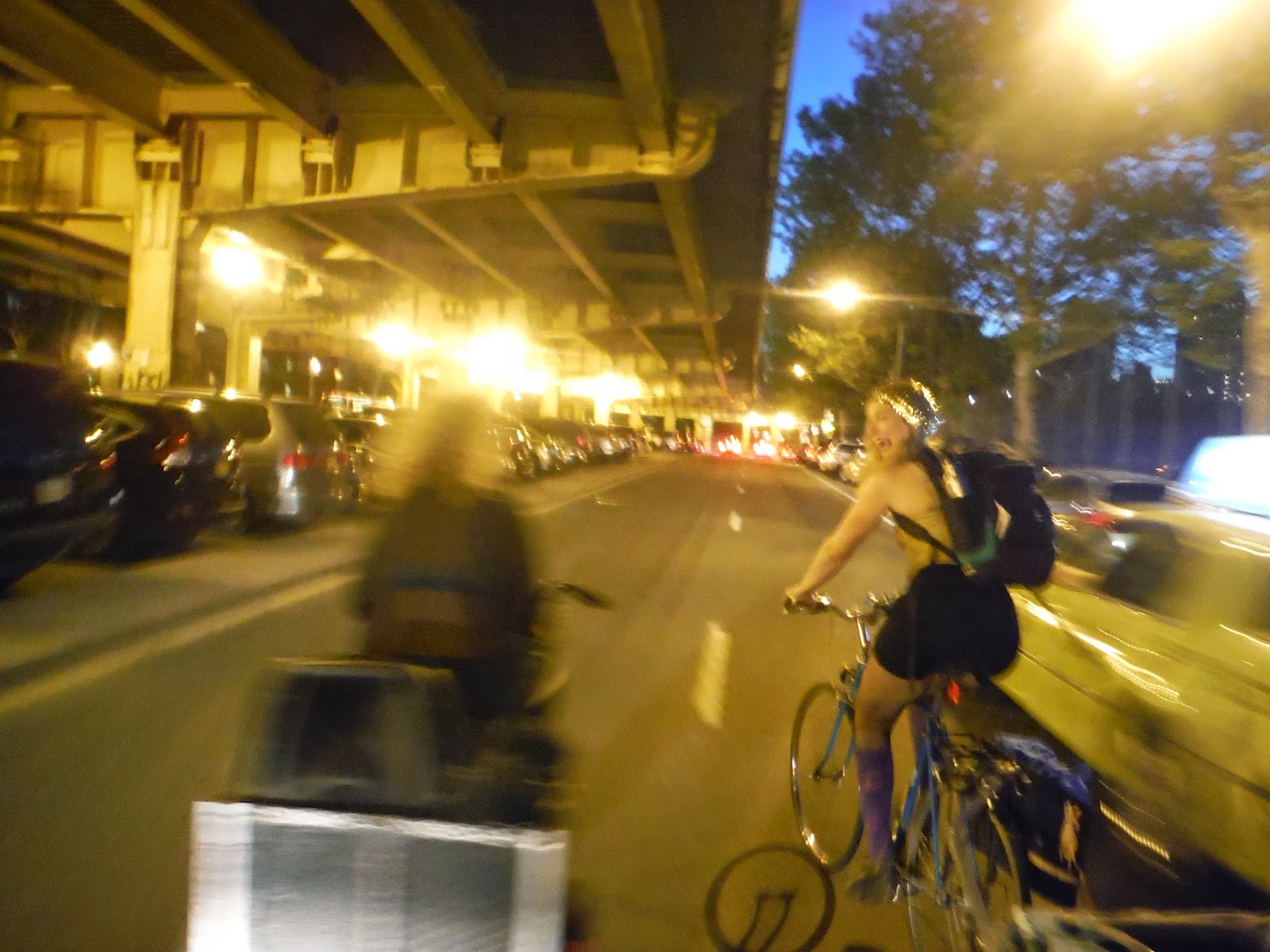
This year, Joe was leaving, so we held a small goodbye, ride on Thursday, meeting at 7:05 at the Brooklyn side of the Manhattan Bridge.


Most everyone was there, but Joe, who elected to be fashionably late.


Monica was waiting for us at a park nearby, where  New York Bike Dance was choreographing a new number they were going to try out.


We stayed in the park for a while listening to music, dancing, riding in circles through the park, eventually making our way into the streets.  Listening to the Sugar Hill gang, rappers delight, we rode through the night.  The sun setting, we made our way to Prospect Park, where more people met up with the ride.


We blasted Abba, Moullinex, Lou Reed, Jimmy Cliff.  And hung out in Grand Army Plaza for hours, dancing and chatting all.  The public space party is about being in public space, enjoying a bit of the party of urban life together. 

So we enjoyed it, gossiped about burning man, and updated Joe “Free Speech or Speech Free” signs.

Part of what I love about these spring rides is the way we forget about the rules for a while and let go, abandoning care or concern for anything.


Of course, the city has ways of reminding us of these things.  But for a while there, we all enjoyed a night in the city, reveling in what the public space party of the streets really can be. This is a place where we meet our city of friends, listen to music, and co exist without an entrance fee.  It is a space to be allowed to be ourselves.  It is a space for connecting and sharing.  It is a space for a Critical Mass to come alive, if only for a night in time.


So, goodbye mellow yellow, but hello to everyone else, hello all you freaks who ride through time with me, shaking in the public space party of the streets.  The streets are ours.  Lets celebrate them together, through time.

Poem to the Freaks - bu Jack Micheline

To lives as I have done is surely absurd
in cheap hotels and furnished rooms
To walk up side streets and down back alleys
talking to oneself
and screaming to the sky obscenities
That the arts is rotten....
That mediocrity and the rage of fashion rules
My poems and paintings piled on the floor
TO be one with himself
A saint
A prince
To Persevere
THrough storms and hard-ons
Through dusk and dawns
TO kick death in teh ass
To be passed over life a bad penny
A midget
An art
A roach
A freak
A Hot Piece
An Outlaw
Riase your cup and drink my friend
Drink for those who walk alone in the night
             To the crippled and the blind
             To the lost and the damned
             To the long bird flying in the sky

Drink to wonder
Drink to me
Drink to pussy and dreams
Drink to madness and stars
I hear the birds singing. 


Monday, May 11, 2015

Kramer vs Kramer, Ordinary People and the Making and Breaking of Affectional Bonds


Its hard to date the moment when I first became aware that I wanted to be a social worker.  Like most things in my life, my interest in it grew out of the movies, life, and struggles in between.  This weekend, we watched two of the movies that informed that disposition, reviewing the stories of fellow travelers going through their struggles to make sense of the world, with its breaks, connections, ruptures, and moments where we connect once more.   


I can’t remember which I saw first – Ordinary People, 1980, or Kramer vs Kramer, 1979, – but both touched me. Stories of families grappling with loss, they highlight the way people let each other down, and others swoop in to offer support.  Neither romanticizes the point, but they point to the value of essential others, attachment, and affectional bonds we all need to grow, develop trust, and foster resiliency, as we connect, bond, fuse with others, and separate. Yet when they break prematurely, so do we.  This is the story of Ordinary People.  When the protagonist Conrad’s teenage brother dies in a boating trip, he is left to pick up the pieces of his memories, grief, and guilt for having survived. Few seem to understand, a mother walks away, and a friend from the hospital where he stayed after he tried to take his life takes her life, and Conrad’s therapist steps in, offering guidance, authenticity, and a reminder that maybe it is not his fault that he held on. Maybe he did not do anything wrong after all. 

Watching this film over three decades ago, I was fascinated with what it could show us about how we manage, adapt, and cope with very real pain, the awkwardness of not being able to get along with peers, and the ways a new supporter can move us through such moments.


The film also highlighted the specter of a distant mother, who could not quite connect with her son. Gradually the family and marriage comes apart, while the father and son become closer, sharing their own mutual engagement in making sense of their loss, while the mother becomes more and more estranged.  It is hard for me not to think of Dad and our years together in Dallas before his divorce to my mother became finalized. We watched Ordinary People and talked about Mary Tyler Moore and my mom.  Dad compared the two, perhaps unfairly.  What was similar was  the marriages in the movie and in life that both broke down. 


Kramer vs Kramer, another story about divorce, only extended this thinking. None of us choose parents. And parents certainly do not choose us.  But we all need each other in families.  Yet, when our attachments are broken we all suffer.  Capacity for trust is eroded, resilience challenged.  Hopefully, we come out the other side, coping and growing up together.  That was the story with my father and I.  It was the story in Kramer vs Kramer.  But the pain in between is very, very real.

Early in the film, Dustin Hoffman tells his wife about someone in the office, whispering, “committed suicide.”

My   first godfather killed himself some four decades ago.  His son suffered for years afterward. I will never forget when my parents told me about what happened. The week before, we had been hanging out.  And now he was gone.  It was the first of many such laments.  And it still feels odd to remember.  Maybe this was what all those serious parents in the movies, or even my parents for that matter, maybe this was what they were talking about late into the night? 

Kramer vs Kramer and Ordinary People were movies about a generation that learned to make sense of divorce, seeing its vast impacts on all us, who survived it, as kids, young adults, and eventually parents ourselves.

I will never forget art class in fifth grade and one of the kids in class, a young girl, and I were talking about dinners at home.  She had had pizza the night before.  I told her that sounded great.
“Not if you have it every night,” she lamented and started crying.  There was something else there. Her parents, like most of the kids in my grade, were separating.

My family suffered divorce, as did most of my friends, and I regret the pain of that separation to this day. But of course, we adapt as we all did, as the characters in the movies do, as we are all forced to.

My kids and I talked about the movies all weekend, how good they were, and how sad they seemed.  They were in awe of the younger Meryl Streep.  But who could imagine a mom leaving in that way?  And they were sad for the son left behind.


But the making and breaking of affectional bonds is real and long lasting.  Its something we spend forever rehashing, as we navigate the course of our lives, from growing connected to parents, separating from them, making our way through the world, and connecting with others through time.


I am still glad those movies were made and to watch them with my kids, who I hope will avoid enduring such breaks.  But we can’t avoid life and its pain.  We cannot avoid it.  I just hope it won’t hit too hard as they grow through this world. 

Sunday, May 10, 2015

Social Work and sustainable urbanism: from seed bombs and brownfields to community gardens, bike lanes to sustainable urbanism


I have a vivid memory of a cold February bike ride with the Occupy Wall Street Sustainably Committee, collaborating with several garden and cycling groups.  We rode from Zuccotti Park up through some vacant lots throughout the Lower East Side.  Borrowing a page from the Green Guerillas, we spent the ride throwing Seed Bombs into the lots.  Falling, each seed clashed on the ground, colliding with the dirt while laying the groundwork for a new community garden and by extension a different way of looking at the world.  Each offered a new possibly for a spring which just might sprout something wonderful.  Taking part, we were all invited to see urban lots as green spaces and the city as a sustainable space capable of regenerating itself.  Of course, many of these seeds were dislodged from their roots and the earth the following fall when the waves of Hurricane Sandy crashed over the shore.  That’s part of why so many of us, some 400,000 or so were inspired to join the People’s Climate March. Throughout the march, we’d see dinosaurs and swordfish bikes, flooding bodies and bouncing globes, tumbling trees, clashing forces and melting statues, crashing bodies, colliding and creating something new.  I got involved in the organizing for the event only a few days after returning from our summer hike through Spain, attending meeting after meeting, making banner after banner, prop after prop.  The climate march was grand, but the week after was possibly more important.  We all rode through NYC to an old vacant lot, a brown field along vacant railroad between Long Island City and Brooklyn turned community garden, where we planted seed bombs. Doing so, we connected multiple ingredients of urban climate activism, linking the transformation of brownfields into community gardens, bike lanes and non-polluting transportation with models of sustainable urbanism.  The urban farm, dubbed Smiling Hogshead Ranch, would later be made into a city park, where cohorts of youth now learn lessons of urban agriculture and environmental science.  The work connected my experiences with ecological social work, do-it-yourself politics, community gardens, non polluting transportation as parts of expanding model of sustainable urbanism. Exploring these livable models of engagement, this paper connects such elements to outline a livable model of social change activism around models of remediation, cites and climate.        

Eco Social Work

               Social workers have long talked about looking at people in their environments.  Yet, the emphasis has tended to focus on the social world.[i]  Yet, there is a physical world which impacts the lives of people around the world, the majority of whom now live in cities, riddled with brown fields, pollutants, toxic waste, congestion, polluted water, tornados, hurricanes, people fighting over resources, and increasing temperatures.   Social work is well equipped to cope with such challenges, capable of connecting the self and the world we live in, through more holistic models of practice.[ii]  The question is will it?  Will is take on a climate crisis which seems to be hitting a tipping point?[iii]  To do so, the profession of social work could benefit from learning from social movements the world over coping with environmental challenges.  Such thinking merges a view of social work in the context of an ecological crisis, that has been described as a something akin to a game of Jinga: if you take out enough pieces, the whole planet crumbles just like this kids game.[iv]  Engaging in this question, we invite students to examine environmental problems as we take the “Person and Environment” framework seriously, expanding it with a global perspective.  By considering the physical environment we take on a more authentic approach to our profession, while learning to be better equipped to be activists and change agents.  

               I first become a involved with green/environmental social work when, I saw what was happening when humans take Mother Nature for granted, the environmental disasters/hazards and social injustices, such as earthquakes I saw experienced in California, super storms on the East Coast, and skyrocketing asthma rates among low income populations living in toxic environments with few green spaces.  Moving to New York in the mid-1990s, I became avidly involved with community gardens, believing that they are a solution to help us fashion more livable cities.  Yet, there was more to it than this.  Many of the people involved with urban gardening were also involved with efforts around non-polluting forms of transportation, connecting streets with green spaces. Together, we worked to clean up polluted urban spaces and using tools such as bio-remediation  to  help fix such spaces and possibly the planet.

Through such community practice, practitioners and activists hone a fresh and analytical picture of a new positive (= solution-oriented ) opportunities of social work in enabling sustainable urban communities to grow by turning towards social activism, opening a community based path for social work as a profession and a practice, ideally moving it beyond the crossroads the editors identify in the introduction.  Here, the distinctions between solutions oriented social work and social policy are bridged within an engaged practice.  Countless models of research can be cited which build on this model of sustainable urbanism.[v]   

Yet, to do so, many organizers take a distinct approach to coping with social problems, beginning with community organizing and development, extending through four core areas of sustainable urbanism.  These include: dialogue and deliberation to examine options for meeting the challenges, remediation to fix what is wrong, prevention and development to slow problems while creating alternatives, and social justice based models of social action, from direct action to direct services.[vi]   Models of remediation involve taking what is wrong with the world and fixing them.  For example, bioremediation is “a process by which microorganisms, fungi, and plants degrade pollutant chemicals through use or transformation of the substances.” [vii]  Here, everyday materials, such as oyster shells and mushrooms, break down oil from spills, reminding us there are simple feasible solutions to countless problems we face in our communities; in a nutshell, grow mushrooms, clean the earth.[viii]  But remediation extends in countless directions.   For example, members of the Occupy Wall Street Sustainability Committee held various bioremediation balls in a community gardens, wherein members played and experimented with natural elements.  “Eat oysters for the shells, make mud balls for waterways,” noted the invitation for the 2014 Bioremediation Ball. “Learn the Pharma Seed game for future pharmacy, sow sunflower seeds to pull toxins from soil, crush shells for soil, grow mushrooms, stomp cob for bricks, make egg-carton balls for play...”  The group connected countless community development strategies, linking direct action to direct services, mutual aid, dialog and deliberation, with efforts to create and support spaces, such as community gardens like El Jardin Paraiso where the Bioremediation Ball took place.  Here, people talk, listen, share skills, and build community.  

For cyclists, the approach builds on what is known as the Copenhagen Theory of Change, whereby regular people are engaged to support small gestures, of personal changes which have a large impact on cities.  Rather than waiting for a solution at a policy meeting, regular people find their own solutions in themselves. Five decades ago, the people of Copenhagen were as reliant on cars as those in the most suburban places in the world.  But after the oil crisis and a spike in child deaths by automobiles, the Dutch ‘Stop de Kindermoord’ (Stop the Child Murder) movement ignited a change.  Hereby, regular people made a commitment to cycle more and drive less, thereby reducing carbon emissions and deaths by automobile.   Today, most everyone there rides bikes rather than drives to work.[ix]  Such practice is very much built of a do-it-yourself approach to activism and community engagement, wherein individual people committed to save the climate by taking multiple small actions.  Imagine if every city around the world emulated the Copenhagen approach to non-polluting transportation and New York’s approach to allowing neighborhoods to create community gardens?  We might start to move in the right direction. Through the application of this approach, we can trace a lineage of activism, from direct action based campaigns to create public space, community gardens, and non-polluting transportation offering a future of cities, pointing us toward a more livable world.

DIY

               Through DIY politics, we consider contradictions between ideas and art, bodies and movements on streets and public spaces.  Along the way, a dialectical approach helps us explore the interconnections between street activism and social history.  “Themes of imagination, creativity and desire run throughout the radical left movements,” explains Shukaitis.[x]  Such thinking ties together projects ranging from Mujeres Libres to today’s Critical Mass bike rides.  Often neglected, these help remind us that we are not passive spectators of history. There are other ways of living. It is up to us to recreate them and set out a path toward different kinds of stories.  They help us think of cites as mutable DIY spaces we can impact through the merging of our liberatory gestures and direct action with a closer, more humane model of what cites can and should be, one garden, bike ride and prank at a time.   Through such actions, cites are engaged in a process of becoming.  We can all be part of this.

               I first started thinking about such a politics as an organizer and social worker, balancing my days working with people with AIDS in the Bronx and organizing in the Lower East Side of Manhattan, where I lived.  There, we connected struggles to save urban gardens with the deforestation Earth First was contesting on the West Coast of the United State.  Many of us took part in the Battle of Seattle that fall of 1999, connecting various DIY campaigns.[xi]  Here  a problem solving, community building spirit extended from punk to a do it yourself ethos, building a community with what ever one had, with zines, music, people getting together and creating a public space. Such an ambition extended from squatting homes out of abandoned buildings to creating shows for your friends- building something of one’s own own.  People want something authentic with which to connect.  Hence the appeal of punk shows, dance music, rave culture in 90s in Britain, loud, pulsing bands, and other cultural streams anarchism.  It's people sharing a space together, a bohemian space, a blurry space - ambivalent sexual space, where desires reflect the biodiversity of nature and vice versa.  Here we found life was far more random than any of us could imagine.                

               When I got to NY in the mid 90s, I found the Lower East Side Collective, where we organized in an intersectional way, working with local anarchists, squatters, graduate students, and even local elected Democrats - whoever we needed to work with.  We had a strike team, a public space, a community gardening group, community labor coalition;  we did graffiti, sticking campaigns, our big events were dance events,  dancing and building a community together.  We didn't believe in any isms.  Every three weeks we had a general community meeting; everyone had 3 minutes to say what their project had done, what they wanted.  Not allowed to talk about ideology.  Meetings were short, five affinity groups getting together.  We got green grocers back wages, created community gardens, and participated in the workings of a movement which would later be dubbed the global justice movement, helping it link local ambitions, gardens, squats, and aids activism with global activism.[xii]  

DiY is more than any ideology or political philosophy; rather it builds on a diverse culture of anarchism, cultural activism, and community organization.   Through it, regular people come together to organize, injecting a pulse of freedom into the practice of social change work,  connecting autonomy of bodies and freedom to be queer in public space.  This is anarchism in self organization and self determination.  The idea is affinity groups, ten of us in the room can do it ourselves. That's what the other best campaigns, ACT UP and Occupy, do.  It is born through retail politics – people shaking hands, having a conversation, unmerited marches – expanding an awareness of pubic commons. This commons we are talking about, is earth.  

Practicing this approach, many of us are acutely aware that our city, New York City faces a stark choice: either will be transformed into a sustainable city or it will be flooded.  Yet, solutions are everywhere.  We can walk; we can use solar energy, ride bikes, expand our own sustainable agriculture – and hopefully survive this, trying to use common sense tools, greening public space, supporting alternative energy.   If not we'll see more Super storm Sandys.

We are already seeing the benefits of this approach.             The city has made bike lanes because a lot of people said we'll ride.   When Super Storm Sandy hit, Occupy Sandy, groups of organizers - brought cargo and energy bikes with marine power batteries, to help people recharge, connect, get supplies and talk.  Under the slogan, "Mutual aid, not charity".  Cyclists moved thousands of pounds of food from Brooklyn to Queens, charging phones in the Rockaways, and pointing to the possibilities of non-polluting transportation as a vital resource for post disaster cities. [xiii] The best organizing takes place when people have a conversation.  Throughout this activism, we considered the social, cultural and ecological costs of life in cities and redevelopment, wondering if there could be a different more ecologically balanced, livable, more community based model for development.  Could there be another story?  Will this city follow a path toward more ecological disrepair or toward sustainable urbanism?

Social movements and creative activism are fundamentally about telling many different kinds of stories, engaging  the polyglot nature of our society rather than submitting to the limitations of a single narrative. Here, the practice and art and activism merges into a distinct mode of artistic activism, aimed at transforming urban spaces into living, breathing, mutable works of art. Some look to paint brushes and graffiti. Others use their bodies or public spaces. McKay and Furness  look to gardening and cycling as ways of creating new models of sustainable urbanism. Nettle and McKay  fashions gardening as a form of resistance culture, as a model of social action, tracing an alternative history of the practice. [xiv]

Gardens, bikes and urban ecology

This is a city connected between people and ideas, streets and green spaces, bike lanes and sidewalks, spaces for cars, and pedestrians, as well as those who yearn for public spaces, where they can actually put their hands in the dirt – everyone sharing delicate community ecology, worth preserving and honoring.   When we lose a green space, this balance is threatened in a similar way. We lose our sense of community or self. The private invades the public.  Everything is interconnected in this naked city.

https://blogger.googleusercontent.com/img/b/R29vZ2xl/AVvXsEiGj8Ufx4KLnmoq3CaQcUgavRsSNJQfvX4LRd7OTO8tb6chj1io6LwY_4ww9NVIFMIhtfbX1Wgr7l679SYZkD7cUHsuUwOIl13bQVxRlIu286f-qrzpE-3uyOkUTGge_2m-OCI3B3dgwZI/s1600/096.jpg

One Saturday in  April of 2015, I left the house to make streets memorials for pedestrians killed by automobiles in the morning and to highlight community gardens under threat in New York City.  After the morning of painting memorials, I dropped by the Brooklyn Commons, where they were putting on workshop on climate justice.  “Everything is connected,” declared the sign.  And that’s the point.  All winter long, we pointed out that green housing is not built on green gardens, that community gardens help offer a solution to a city facing the threats of flooding, climate extremes, congestion, and rippling threats to the sustainability of the city. They should not be sacrificed.  These spaces offer a wide number of benefits to our concrete jungle, making cities better spaces in which to live.  A few of these include:

1)     Providing food security, nutrients, and resources to underserved communities.

2)     Reducing food and transportation costs.

3)     Lessening the “heat island” effects in local areas.

4)     Promoting civil engagement in the same way social settlements once did.

5)     Reducing food waste via composting.[xv]

Part of what is important about these stories and approaches is the way they point to forms of activism which impacts everyday life. One need not purchase a train or airplane ticket or use sick days to participate in these forms of activism, which are transforming cities the world over. Through such low threshold endeavors, everyone can take part in shaping their city as a work of art. All you have to do is get on your bike and ride, join your local community garden or create your own solution.


[i] Bronfronbrenner, 1979. The Ecology of Human Development. Cambridge MA, Harvard University Press.
[ii] See Introduction to this book. Aila-Leena and Kati Narhi. Social work and social policy in the context of a comprehensive ecosocial transition of societies.   Also see Loretta Pyles and Gwendolyn J. Adam.  Eds. 2016. Holistic Engagement: Transformative Social Work Education in the 21st Century. Oxford University Press
[iii] Barnosky, Anthony et al. 2012.  Approaching a State Shift in the Earth’s Atmosphere. Nature. http://web.stanford.edu/group/hadlylab/_pdfs/Barnoskyetal2012.pdf
[iv] Bill Nye. Climate 101. http://climaterealityproject.org/video/climate-101-bill-nye

[v] HEssle, Sven. 2014.  Environmental Change and Sustainable Social Development: Social Work-Social Development Volume II.  Ashgate.Shepard, Benjamin. 2012.  Community Gardens, Creative Community Organizing & Environmental Activism.  In Gray, M., Coates, J., Hetherington, T. (2012). Environmental Social Work. New York: Routledge. Shepard, Benjamin 2014. Community Projects as Social Activism. Sage 2014. Shepard, Benjamin. 2015 Rebel Friendships. New York: Palgrave Shepard, Benjamin. 2011.  Play, Creativity and Social Movements: If I Can’t Dance Its Not My Revolution, New York: Routledge. Shepard, Benjamin and Smithsimon, Greg. 2011. The Beach Beneath the Streets: Contesting New York’s Public Spaces. New York SUNY Press.

[vi] Shepard, B. Totten, V., Homans, M. (2012). The Human Services Response to Social Problems – How, Who, and Why. Plenary Address National Organization of Human Services Conference.  Milwaukee, Wi.
[vii] Rhodes, C. (2014). Mycoremediation (Bioremediation with Fungi) – Growing Mushrooms to Clean the Earth. A mini-review. Chemical Speciation &Bioavailability Accessed 30 January fromhttp://www.sciencereviews2000.co.uk/view/journal/chemical-speciation-and-bioavailability
[viii] Rhodes, 2014
[ix] Gernot Wagner. 2015. Climate Shock: The Economic Consequences of a Hotter Planet. Princeton University Press: Princeton, NJ.
[x] Shukaitis, Stevphen. 2009. Imaginal Machines: Autonomy & Self-Organization in the Revolutions of Everyday Life: Autonomy & Self-Organization in the Revolutions of Everyday Life.  Autonomedia. 2009 (pp. 13–14).
[xi] Duncombe, Steve. 1997.  Notes from the Underground.  Zines and the Politics of Underground
Culture. Verso New York.  George McKay. 1998. DiY Culture: Party and Protest in Nineties Britain.London: Verso.
[xii] Shepard, Benjamin. 2011.  Play, Creativity and Social Movements.  New York: Routledge.
[xiii] Shepard, B (2013). From Flooded Neighborhoods to Sustainable Urbanism: A New York Diary.  Socialism and Democracy.  27(2): 42-46
[xiv] George Mckay. 2011. Radical Gardening: Politics, Idealism, and Rebellion in the Garden. Frances Lincoln. London; Zack Furness 2010. one less car: bicycling and the politics of automobility. Temple University Press; Claire Nettle. 2014.  Community Gardening as Social Activism.  Ashgate; Efrat Eizenberg. 2013.  From the Ground Up. Community Gardens in New York City and the Politics of Spacial Transformation. UK: Ashgate.
[xv] Allison Paisner. 2015.  Five Reasons Why You Should be Promoting Urban Agriculture in Your City. 9 May. www.publicceo.com/2015/05/five-reasons-you-should-be-promoting-urban-agriculture-in-your-city/.